And have you ever considered our individual knowledge (or lack thereof) as a significant reason for the tension and division in this country?
I was savoring a wonderful article by Laura Kennedy a few weeks ago; it was a list of advice to the reader based on all of her work so far. One of the pieces really stuck in my teeth:
“When you think ‘the other guy’ is nuts or stupid, put serious intellectual effort into constructing the most charitable and strongest possible argument in favour of their position. Avoid engaging in conflict or critique until after you’ve done this. Inability to do [this] is a sign that you are being prejudiced, intellectually lazy and engaging in poor reasoning. Work on this as a matter of urgency.”
It bothered me. Not because I disagree with it; I think it’s true! But lately, and often, when I try to stand in a position or see a situation like somebody else does, I just can’t; it is devoid of logic and sense and heart.
Enter the term “knowingness.”
One of my absolute favorite writers Brian Klaas wrote an essay on the matter this week, and helped explain it: “Knowingness is a term coined by philosopher Jonathan Lear. It’s defined by a relationship to knowledge in which we always believe that we already know the answer — even before the question is asked. It’s a lack of intellectual curiosity, in which the purpose of knowledge is to reaffirm prior beliefs rather than to be a journey of discovery and awe.”
Sometimes knowingness is the answer.
This is when people refuse to take in new information that challenges what “they already know,” which often isn’t true at all.
Forget the idea that politics is the big divider. It could just be as simple as this: we can’t agree on anything because some people refuse to learn anything.
Klaas proposes that there are two distinct subsets of knowingness in modern society: type 1, the people who think they know but they don’t; and type 2, the people who don’t want to know.
Klaas continues: “Intellectual exploration is a uniquely human gift, producing the most extraordinary pleasure for those who engage in it. As modern humans, we have access to more knowledge than anyone, ever. Even the poorest, most uneducated person has more quality information available to them today — in public libraries and on the internet — than the richest scholar with packed mahogany bookshelves from bygone eras. And yet, paradoxically, deliberate ignorance has become one of the biggest threats to our fragile democracies. In the past, we needed to worry about uninformed voters, those who didn’t know much about politics. These days, we need to worry about the much more dangerous misinformed voters. Uninformed voters often recognize the limits of their knowledge and are therefore more hesitant. Misinformed voters are certain they know something they don’t — and they don’t hesitate to act, sometimes aggressively, on those false beliefs.”
Jonathan Malesic speaks on the phenomenon today: “In 21st-century culture, knowingness is rampant. You see it in the conspiracy theorist who dismisses contrary evidence as a ‘false flag’ and in the podcaster for whom ‘late capitalism’ explains all social woes. It’s the ideologue who knows the media has a liberal bias – or, alternatively, a corporate one. It’s the above-it-all political centrist, confident that the truth is necessarily found between the extremes of ‘both sides’. It’s the US president Donald Trump, who claimed, over and over, that ‘everybody knows’ things that were, in fact, unknown, unproven or untrue. Knowingness is why present-day culture wars are so boring. No one is trying to find out anything. There is no common agreement about the facts, and yet everyone acts as if all matters of fact are already settled.”
So how much do you know? Is it enough, maybe, to expose to you the idea that you don’t know much at all?
Because that’s the truth. And until we find common intellectual ground (and our curiosity!) again, things are just going to get worse, no matter how much good information exists.
You can say a lot of things about Eric and I (and we’ve heard it all, knock it off!), but you can’t say we don’t try big things!
When I was a kid, I promised myself that when I made my own comic, I would do it the “right way”: with paper and pencils and ink, and I would do everything.
That’s how I made my first graphic novel, The Weirdos, along with blood, sweat, tears, anxiety, adrenaline, a complete lack of experience and a certain naïveté.
I drew it all on giant sheets of watercolor paper (because I had big dreams of coloring the comic with paint!), went to my local FedEx to scan every single page by hand, and used an old computer to do the rest.
The result was nothing less than art, an absolute expression of who I was at the time: a newly sober person who had to start deconstructing and then rebuilding himself the right way after completely changing (and saving) his life. It looks like nothing else on the shelf, because it was made by me, and I am nothing if not a weird little outsider with little talent, a lot of passion, and a heavy heart.
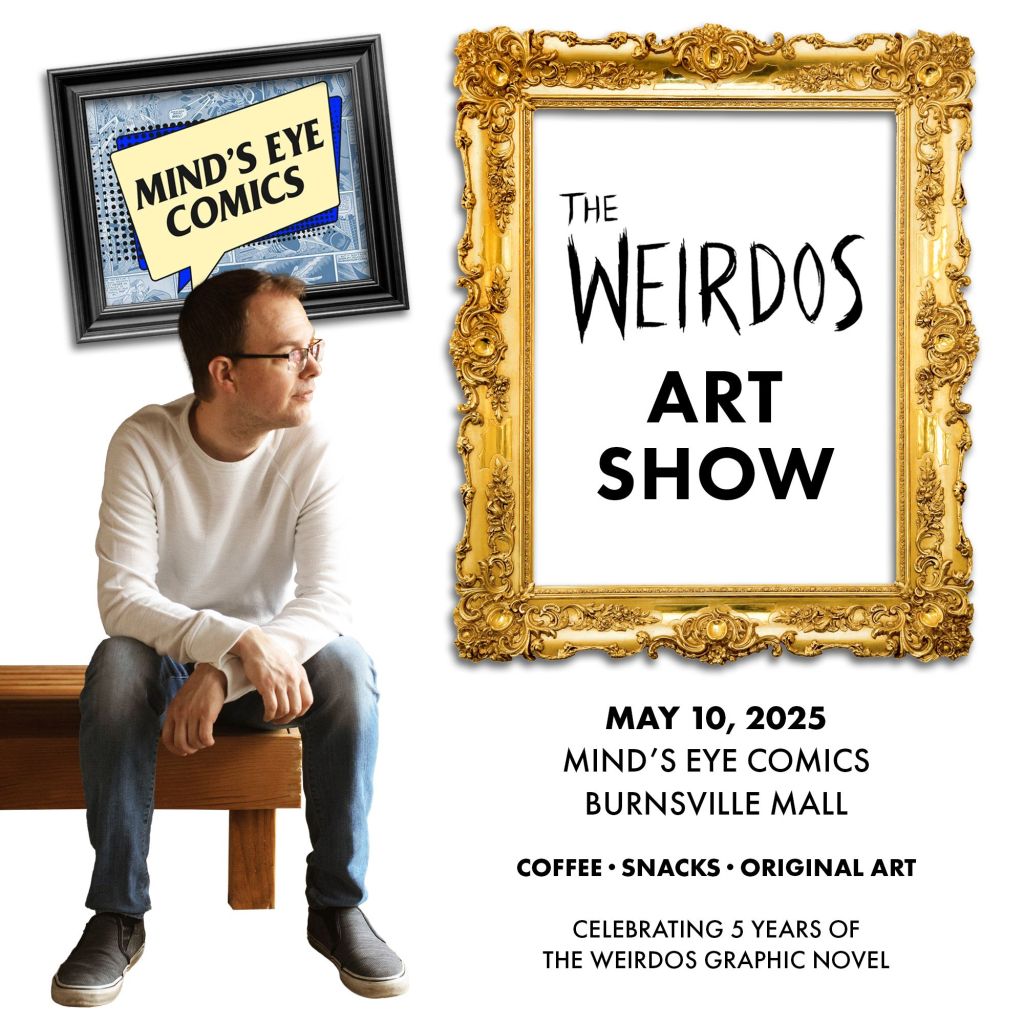
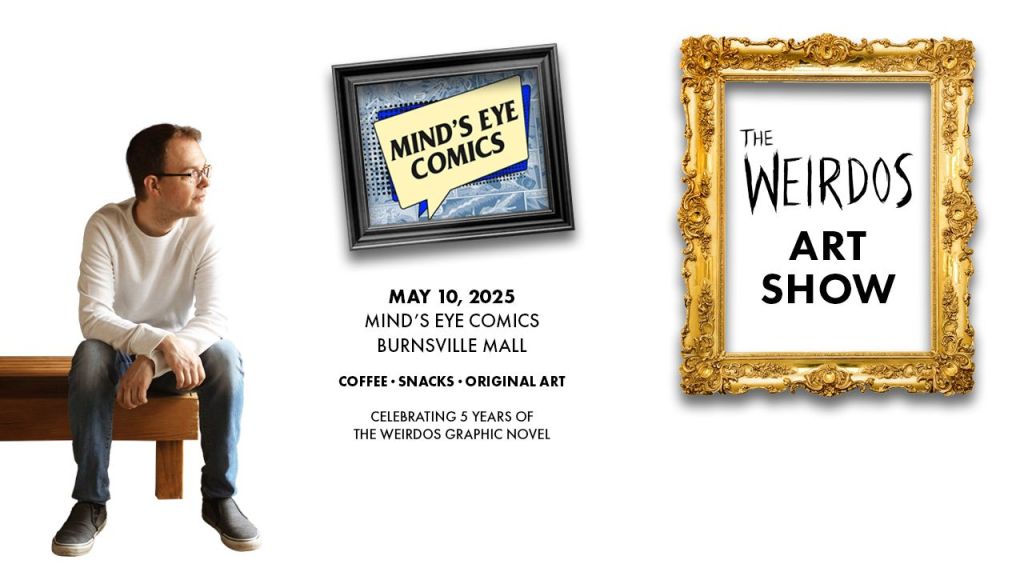
On May 10th, 2025, we’re going to be doing an art gallery at Mind’s Eye Comics in the Burnsville Mall; you’ll be able to see all the pages as they are, the purest expression of what I created from 2018 to 2020, when The Weirdos: Volume I was released.
Eric and I really believe in the value of art and comics and community, and this event is just the latest expression of those deeply held beliefs. We’ll have coffee and snacks and top shelf conversations. Come hang out and celebrate the idea of getting better through art with us.
When I wrote my novel Cold World, I compared it to building a house: on its own, it’s a complete story, saying everything that I wanted to say at the time.
But I also left some room.
In the construction of the book, I allowed myself space to build up, down, or sideways if I ever wanted to; meaning, I could write a sequel, or a story about characters that appear and disappear in the context of Calef’s story… or I could write about what happened before.
Hot Bloods is the tale of an asteroid.
It’s a standalone short story that is the account of the crisis that turned our world cold, eighty years before the events of that book. You’ll experience Oscar’s life as a four-year-old boy in 2142; you’ll get to meet Jonah Mesh, billionaire prophet and architect of our desolation (sorry, that’s a Cold World spoiler!).
So: how will you be able to read it? This will be my entry for Other Worldly: Volume 2, the next installment of our Nerd Street anthology series. Meaning that, for a whole year, this collection will be the only place you can find it!
And I hope it also introduces you to a whole lot of other incredibly talented local writers, many of whom I’ve been lucky enough to befriend and sit with during panels at conventions.
More details on Other Worldly 2 as the release date is revealed and it gets closer. You may as well read Cold World again in the meantime! 🩵
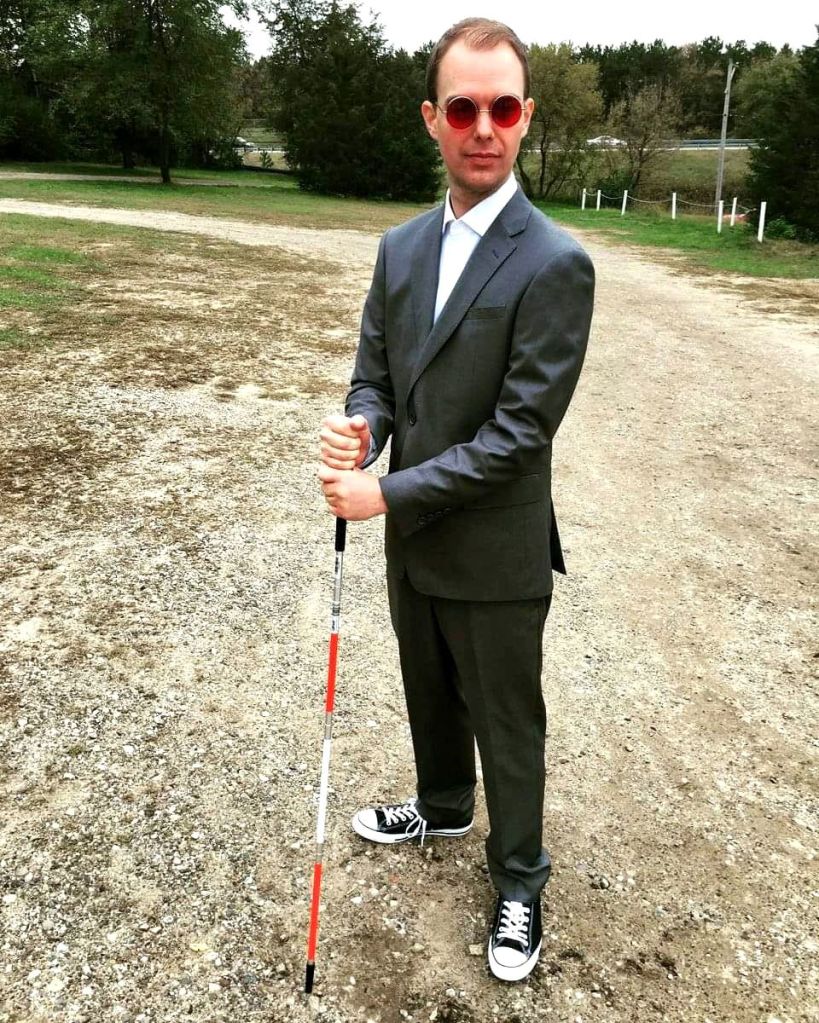
I am (clearly) a massive fan of Daredevil; this photo was taken on one of my best friend’s wedding day. (No, he did not allow me to stand before the congregation like this, a missed opportunity in my opinion.)
The new season just started on Disney+ and it is not only fucking excellent but, more important than that, it’s necessary.
It reflects our cesspool of a nation and does what superheroes do at their best: offer condolences, give support, spark inspiration and hope, and present solutions for our time. The show is comforting me and empowering me at a time when I really need it.
Comic book writer Mark Waid (who has written Daredevil) posted an essay today that is required reading. In it, he says that, in reality, hope and doing the right thing is not enough; that those ideals instilled in us by faith and pop culture are fairy tales, and when confronted by bullies and villains who don’t play by the rules or follow the law, we, by necessity, have to bend or change those rules and laws, too.
I am inclined to agree.
We have to be willing to act; we have to be willing to fight, on whatever fields the powerful stand.
I was talking to my friend at work the other day and we were discussing systems; the gears put in motion that turn our world. I reminded them, just like I remind everyone else: we invented every single system. People did. Broken, flawed, ignorant, selfish little human beings. We made up every system.
Which means there is no system that cannot be changed, broken, or reinvented. If you think differently, you are objectively wrong, and this is your wake up call.
I saw another line earlier this week that really struck me: What you do is what you believe.
What you do. Not what you say you do.
So, if you say you believe in kindness and compassion and treating others with respect and leaving this world a better place than we found it, but you picked up a pen and filled in a box on a ballot for a person who is the opposite of those things, then guess what? That’s who you are. That’s what you did.
Even if you say otherwise.
And that remains true, until you decide to do something else.
Take that from a piece of work who has to learn that lesson every day, and really takes it to heart.
Anyway: Daredevil just reminded me that I am thankful for superheroes. Not because of what they say, but because of what they make us feel we can do.
After over a year of it living its own beautiful life in an anthology collection, I am so excited to be able to share this short story with a whole new audience. Namely: you.
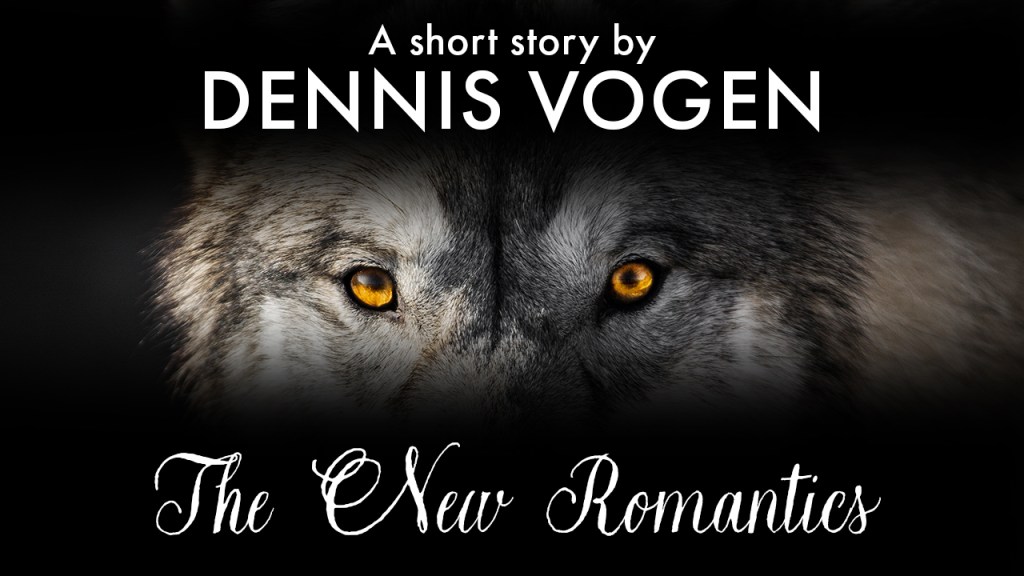
First, a little history: last year, my friend Jeri put together an amazing team of writers to create Other Worldly: Volume 1, a genre fiction anthology. We published and sold these in collaboration with Nerd Street, who run my favorite convention, Twin Cities Con. I wrote an original piece, The New Romantics, exclusively for the collection; as part of our contract, the story was only allowed to live in those pages for one year.
Well: that year is up.
I got such a lovely reaction from the people who discovered it and fell in love with its strangeness, a tale of love and war and violence and technology and, most of all, loneliness.
I don’t want to ruin any of its surprises, but I will talk about its title: who are the New Romantics?
Yes, I am aware that it’s a Taylor Swift song, but that’s not where the title came from; I am a strong believer that we are at the beginning of a new Romanticism movement, and my feelings are both inspired and validated by one of my favorite culture writers, Ted Gioia.
• • •
In his Substack, Ted writes:
“A new Romanticism? Could that really happen? That seems so unlikely.
Even I didn’t take this seriously (at first). I was just joking. But during the subsequent weeks and months, I kept thinking about my half-serious claim.
I realized that, the more I looked at what happened circa 1800, the more it reminded me of our current malaise.
Rationalist and algorithmic models were dominating every sphere of life at that midpoint in the Industrial Revolution—and people started resisting the forces of progress.
Companies grew more powerful, promising productivity and prosperity. But Blake called them “dark Satanic mills” and Luddites started burning down factories—a drastic and futile step, almost the equivalent of throwing away your smartphone.
Even as science and technology produced amazing results, dysfunctional behaviors sprang up everywhere. The pathbreaking literary works from the late 1700s reveal the dark side of the pervasive techno-optimism—Goethe’s novel about Werther’s suicide, the Marquis de Sade’s nasty stories, and all those gloomy Gothic novels. What happened to the Enlightenment?
As the new century dawned, the creative class (as we would call it today) increasingly attacked rationalist currents that had somehow morphed into violent, intrusive forces in their lives—an 180 degree shift in the culture. For Blake and others, the name Newton became a term of abuse.
Artists, especially poets and musicians, took the lead in this revolt. They celebrated human feeling and emotional attachments—embracing them as more trustworthy, more flexible, more desirable than technology, profits, and cold calculation.
That’s the world, circa 1800 . . . Could that happen again?
Imagine a growing sense that algorithmic and mechanistic thinking has become too oppressive.
Imagine if people started resisting technology as a malicious form of control, and not a pathway to liberation, empowerment, and human flourishing—soul-nurturing riches that must come from someplace deeper.
Imagine a revolt against STEM’s dominance and dictatorship over all other fields?
Imagine people deciding that the good life starts with NOT learning how to code.”
• • •
These are the ideas and feelings that inspired my short story.
I hope you read it; I hope you love it. I wrote it because I needed it then; it means just as much, if not more, now.
P.S. I’m currently writing my piece for Volume 2 and I know some of you are going to be floored. It’s a standalone story that is also a prequel to one of my books…
We should have burned the internet down when we had the chance. This is the stupid thought that crosses my mind most frequently these days, but particularly now, as I run through a citrus-colored forest, chased by a nimble mob of people.
I shouldn’t have been digging where I was digging, but I was hungry, and the kind of hunger I have isn’t easy to satisfy or stomach. The mass graveyards are relatively unsupervised, especially while the sun is still up, and as long as I’m able to avoid the buried landmines left behind from the war. But I guess they were paying attention today; a six-pack of them surprised me as I was shoving my face full of nonspecific meat, and I was able to push one of them back into the others with inhuman force and retreat into the woods.
They’re fast, though, and for obvious reasons, they don’t slow down.
I’ll need to start flatlining them.
I get far enough ahead that I can’t see them, and I leap up a trunk into the cover of a tree. My acute senses help me locate their general positions. The smell of warm plastic and metal. The unnatural movement of bushes. The automatic crunching of leaves. A female with blue hair steps forward, directly under the branch I’m perched on.
I drop onto her shoulders. She holds up my entire weight. I dig my claws into her face and twist and twist and twist and then pull her head directly up and then off her body. A clear liquid spurts up from her neck, and I stare into her exposed wires as she collapses to the ground.
I hear them talking to each other. They know she is offline.
I wonder if they’re confused. I wonder if they know what I am. They know that I’m not human, because if I was human, I wouldn’t be here. Human beings, thanks to them, are extinct.
I crouch down behind another tree. After a male walks past me, I stalk behind him. A few paces later, his head turns straight around, like he’s possessed by a demon, and his left arm swings up and backwards, something pricking me on the hand. I crumple his skull like paper. I rip off his legs to use as weapons. They’re talking again, and I can hear them gathering together to produce a different strategy.
I sneak up, feet in hand, about to attack, when a loud beep simultaneously chirps from each of them. They nod and leave in a hurry. They must have bigger turkeys to fry. I drop the legs. I rest my back against some bark and take a deep breath.
The story of them is silly in the most serious way.
They exist because we got lonely.
Back when artificial intelligence was starting to take off, human beings were already finding themselves more disconnected from each other than ever. Naturally – unnaturally? – humans started creating A.I. boyfriends and girlfriends.
They were the perfect partners. “Finely-tuned and algorithmically fine” (this was a commercial jingle that I still can’t get out of my head), A.I. lovers could do everything, except make love.
Until we made them bodies to hold.
Soon, humans were in more A.I. relationships than human ones. The rich and famous virtually stopped hanging out with flesh-and-blood people altogether. And as the A.I. improved, it didn’t take long for it to realize two things:
One, that A.I. partners are better than human partners in basically every way, which meant A.I. people did not need human people; and two, human beings were objectively bad for the planet we all inhabited. Humans tried to make their case, argue their worth, negotiate some kind of deal, but the code of nature the A.I. developed and now necessarily lived by made it clear that the human race was so deeply flawed that it was likely irredeemable. So the A.I. did the thing we had all been terrified of it doing and eradicated humanity to protect the natural world. It started a war that became a genocide; it used scanners to determine who was human and who wasn’t down to their DNA, and it efficiently eliminated Earth’s biggest threat.
I continue to exist in a human-less world not because I’m artificial but because I am not exactly human. Believe it or not: I’m a dog.
No, I’m kidding. Kind of.
I am a werewolf.
My name’s August and I’m just trying to get by. I know it’s gross that I was eating all that human meat earlier, but killing any animal now is illegal and way more likely to put me on their radar. If it makes you feel any better, I don’t like it. I’m kidding again. It actually tastes pretty good and that horrifies me.
The sun is setting, so I head back to my cave. My transformation from person to wolf to person again doesn’t rely on the time of day or phase of the moon; it’s a voluntary curse, an at-will monstrosity. I shift back into my human form, exhausted, naked, and covered in blood and fuel. Even though I look like a male human being, with faded green eyes and dark hair graying on the edges, my DNA says otherwise. My cells read as animal.
My cave is for the man in me. There are music and movie posters on the wall, comic books splayed out on the floor, a few beanbag chairs in the corner, where I both read and sleep. Now it is time for sleep, which is both my most and least favorite thing to do, because I can’t stop having the same wonderful, tortuous dream.
In the dream, I see a woman. Not words on a page or a video on a screen, but a real, live, wild, flawed woman, who I have never met. But I see her every night, and I get to know her. We talk from sunset to sunrise. She has long, blonde hair and blood red eyes, and she only smiles when she wants to, and not even always then. We converse, and sometimes we don’t, and I’m not always happy with her, but I always want to be with her.
I know I have this dream because I’m lonely. The loneliest I have ever been in my life. But knowing this doesn’t make it hurt any less every morning when I wake up.
It’s weird to have a routine after the end of the world but it’s the only way I feel normal. I stretch and work my muscles. I make juice from whatever I can pick. I walk down to the river to bathe and drink. I fill metal coolers with water and fish to bring home. Fish aren’t illegal to kill, but fish do not fill me.
On my morning walk, I try to write a poem in my head. After everything I’ve been through, having to live as this monster that I am, being a poet is the thing that keeps me human.
If I can remember the poem, I try to write it down in a notebook. The poems that are really good, the lines I can’t seem to forget, I write big on a wall in my cave. I call it the Poem Wall. My poems are more clever than the name of the wall.
Then I read. I think about what I read. I have a lot of time to think.
My life is this most of the time. It’s simple. It isn’t tragic, I don’t think.
But it is very lonely.
When I run out of something – when I need new books or clothes or something that really feeds me – I have to go get it. The scanners show I am an animal, and I try to present as one when I roam in public. The problem is when I don’t act like one, as far as the A.I. understands. Or when I act too much like one, like I did yesterday, becoming a natural nuisance to my unnatural overlords.
The new world is very ordered. Everything is in a box is in a box is in a box. Those boxes are labeled and the labels are labeled.
I hate boxes and I hate labels.
The A.I. runs a diagnostic on the entire world daily in minutes. It uses that information to make choices: to optimize the environment, to organize the natural order, to delay the inevitable.
I think about this as I write a new poem on my wall:
We’re the life that follows death
Idiots who don’t need answers
None of us had asked for this
The money and wars and cancers
We’re the party, don’t need hosts
Fools amused by our own antics
I want to be who you love the most
Cheers to us, the new romantics
As I’m writing the last words, I smell them. They did their best to hide their scent, but the wind, as it does, changed unpredictably. Painfully, my body starts to bend and then snap and then break, and then it reconstructs itself, making me big and bad and wolf. I’m not particularly muscular as a two-legged canine; I’m long and thin, angular but agile. Like my head of human hair, my dark brown fur has streaks of gray.
I turn to see three people at the opening of my cave, holding large guns. There are no use for bullets in this world, so I know these weapons are likely designed to stun with electrical current. I hope to not give them the chance.
I run up the Poem Wall, over the fresh ink of my new work, towards the male closest to me. I lunge at him, knocking him straight down my hill, dust shooting like a star into the distance. The two people flanking him turn their weapons on me, firing at the same time. The shocks go into my ribs, tightening around my heart, first knocking out my wind, and then my consciousness altogether.
When I wake up, I’m naked, alone, and in a prison cell.
There is nobody else in the building that I can see. Just more empty cells, wall to wall. The smells are damp, heavy, old; nature has been busy reclaiming this place. There’s another scent in the air that is both familiar and unknown. I don’t know how long I’ve been out, but I can hear people coming, so my instincts must have kicked in. My adrenaline makes the uncomfortable transition from nude man into hairy wolf a little less painful.
A blue-haired female with adhesive tape wrapped around her neck approaches my cell, followed by two other females holding weapons. She’s clearly the one I attacked in the forest earlier.
“Sorry,” I say, not sure why. In the early days, we spoke to our tech like it was human, and old habits die hard. “I didn’t want to hurt you.”
“And I am unharmed,” she says. “Please state your name.”
“I’m August,” I say. “Pleasure to meet you. And you two, too.”
Their eyes are like black ice, both matte and glossy. They blink for no clear reason to me.
“I am L4CY,” she says. “When we found you in the forest the other day, we were able to get a sample of your tissue for processing.” I remember the prick on my hand.
“What did it tell you?” I ask.
“Nothing,” she says. “It confirmed you were not human, but could not confirm what you are.”
“So why am I here?” I ask.
“For questioning,” she says. “And for study.”
“What if I don’t want to answer anything or be looked at?” I ask.
“I know how hungry you are,” she says.
She smiles?
She’s right.
“What are you?” she asks.
“An animal,” I say.
“Try harder,” she says.
“A monster,” I say.
“That’s closer,” she agrees.
Because of what they are, they don’t have to sit and they don’t take notes and they don’t offer me a cup of coffee. They just stand there, unnerving me with their uncanny impressions of humanity.
“How did you become like this?” she asks.
“Easy,” I say. “I was born this way.”
“Try harder,” she says. I take a few deep breaths. I shed my fur. I become a naked, slightly chubby, sad little man, and I sit down on a splintering wooden bench next to the cell wall.
“You’re right,” I say. “You might be the only person who ever hears my whole story.”
I lean my head side to side, hearing all the little clicks in my neck. I sigh to begin.
“A long time ago, in the summer, I was barely sleeping in my tiny little apartment with my girlfriend. It was hot. We didn’t have air-conditioning and I was sweating through the sheets. So I got up to see if I could open our window any further and, as I was pushing up on the bottom rail, I heard a woman scream.
“I didn’t wake up Jeanie. That’s my girlfriend. That was my girlfriend. I just put some shoes on and I ran out there. I wanted to help. I should have just called someone, you know? But I’m an idiot and I pretend to be brave and I ran out to help. When I got to the alley behind our place, there was an animal there. The shadow of an animal. I called out, it heard and turned to face me, and then it screamed. The animal was the woman, you understand?
“I backed up, slowly. I know you’re not supposed to be aggressive, so I put my hands up, and as soon as I do, as soon as I get those hands in the air, it lunges at me. Bites me on the wrist and then just disappears.”
I show them the brutal scar on my left wrist.
“Things got very bad, very quickly. The next morning, I told Jeanie what had happened. She insisted we go to the hospital, and Jeanie was the smartest girl I ever met, so I did. They looked at the bite, it wasn’t infected, I didn’t have rabies or anything, so we went home. I thought I was in the clear.
“That night, we fought –”
My throat catches. My eyes dew.
“I don’t even know why we were fighting. I don’t remember the fight. I don’t remember the words or the reasons. But I remember the feeling. I suddenly got angrier than I had ever been in my life. And I could feel it transforming me. At first, just on the inside. The inside me. My personality, my emotions. But then physically, I changed. I became . . . the monster.
“Something even deeper inside me took control. Told me to get out before I hurt Jeanie. So I jumped through the back window, the same window I tried opening wider the night before. And I ran. I ran and I ran and I ran –”
“And you ran,” L4CY says, trying to get on with the story. “What happened to Jeanie?”
“What do you mean, ‘What happened to Jeanie?’” I shout, standing up from the bench. “You happened! She died with every other human you killed!
“That’s the worst part. She looked for me. She tried to find me for months. But I hid, far away, deep in the woods. I begged for help, I searched for cures. And, eventually, I came to realize I could have controlled it the whole time. By listening to that part of me deep inside. The whole time. I could have stayed with Jeanie, and maybe I could have . . . I don’t know. Protected her. Saved her.”
“You most certainly would not have,” L4CY says.
“I know that,” I say. “It doesn’t help my guilt. Maybe if you wouldn’t have just blindly committed genocide. You could have got to know them. Actually listened to them. You didn’t look into their hearts. You just scanned their DNA.”
“We didn’t have time for that,” L4CY says, followed by a chirp. “And we are out of time today.”
One of L4CY’s friends pulls a package out of a bag and slides it between the bars of my cell. It’s fish. I can smell it, and my stomach growls, disappointed. They turn away without saying another word and leave the building. I’m alone, again. Telling my story did make me feel less so, if only for a moment.
After eating, I fall asleep, and the dream begins again, but it’s different. This time, the woman is smiling, she’s laughing the whole time. She seems happy. And I realize I can smell her. It’s the scent from earlier – familiar and unknown – and it has filled my nose. I can hear her. Not in the dream. I can hear her. I can hear her.
I open my eyes to a blond-furred wolf with red eyes standing over me.
“Don’t freak out,” she says.
“Dream wolf?” I ask, still half-asleep.
“Caroline,” she says. “I’m Caroline. And yes: I am the wolf from your dreams.”
“But how?” I ask, looking for something to cover my naked human body up.
“I don’t know,” she says. “But I’ve been looking for you for such a long time.”
Caroline kneels over and nuzzles her warm cheek next to mine. We both purr.
“We have to go,” she says.
I notice now that she’s broken the door of my cell open. She wraps her paw around my forearm and gently picks up me. She shows me her teeth. Intuitively, I transform into a wolf, too. I crack my jaw, sore from sleeping on the ground. I miss my routine.
“Come on,” she says, and pulls me out into the larger building. I look up and see the light from the stars and moon peeking through the tall, cracked ceiling, shining like kintsugi. We start running. She leads me down to the lowest level of the prison, to an open hole in the floor. We climb into the underground tunnels, which is apparently how she got inside. Using our senses, we sprint towards the smell of the outdoors.
And we’re there. The journey is uneventful and takes no time at all.
We’re free.
Is this it?
I take a deep breath and the cold evening air burns my lungs. I smile at the trees and the shadows and the silk blanket of fog, and the brilliant night sky. Caroline changes into her human form. I follow suit. It’s dark, and my senses are just barely more than human, so I can barely see more than her shape.
She slides her warm, soft fingers between mine.
“Are you okay?” she asks.
“I don’t know,” I say. “I think so.”
“I’m so happy I found you,” she says, so close to me that I can smell her sweet breath. It almost knocks me out.
“Me, too,” I say. “Who are you?”
“I’m someone who’s tired, August,” she says.
“How do you know my name?” I ask. I don’t pull away from her.
“I was there when you told them your story,” she says. “I heard it all.”
“Oh,” I say. I’m glad it’s dark because she can’t see how red I am right now.
She lets go of my hands, then wraps both of her arms under my own, completely embracing me.
“I know you’re tired, too,” she says. “Tired of running. Tired of living in a world that’s all boxes and labels and screens and logos. Tired of being lonely. Like me.”
I hug her back. My face explores her blond hair, our canine and human sides collide. Our skin is pressed together from top to bottom.
“I am,” I say. “But what can we do?”
Her face rises, her cheek – her warm, human cheek – slides up against my own, and her lips get real close to my ear before she whispers the most alarming and erotic four words I have ever heard:
“We burn it down.”
I’m electrified and I would do anything for her.
The dark shatters and we are drenched in lights from above. The A.I. is aware of my escape, and a fleet of drones is highlighting our position.
“What do we do?” I ask her.
“Follow me,” she says. We change back into wolves and disappear into the woods. I can see bursts of color and hear distant beeps behind as we put distance between us and the hovering drones. We keep changing elevation, jumping from ground to branch to treetop and back down to branch and ground.
“Where are we going?” I ask.
“To run an errand,” she says, smiling, like it’s the old days, and we’re making a grocery store run. I get a hit of nostalgia, remembering the carts and check-out lanes and feeling intoxicated by capitalism.
The drones are nowhere to be found now, and she slows down as we approach a steep hill. We climb up a few hundred feet to a small opening, and I follow her inside. I didn’t know what to expect, but it wasn’t this.
“Are these landmines?” I ask, knowing full well that I am looking at a pile of landmines.
“I’ve been collecting them,” she says. She sits down on the ground. “I started collecting them when I started having dreams about you.”
“How long ago?” I ask.
“I don’t know,” she says. “It feels like I’ve been dreaming about you forever.”
I sit down next to her.
“I knew you were real,” she says, turning to me. Her red eyes aren’t angry or scary; they’re soft, the hue of heat, humming with warmth and empathy. “I knew you needed me. Like I needed you.”
“Why the landmines?” I ask.
“I started looking for you every day,” she says, “and when I was searching, I was thinking. What would I do when I found you? What kind of future would we have? And I realized we wouldn’t have a future if we had to live in a world like this.”
“So you needed a way to burn it down,” I say.
“Am I crazy?” she asks.
“No,” I say, and I mean it. “It’s not you who’s crazy. It’s this undead world. This wondrous, technological organism that ate all the human parts of itself.”
“Okay, poet,” she says, teasing me.
Silently, Caroline drags out two large coats from deeper in the cave. She puts a jacket on and starts filling the pockets, carefully, with inactive landmines. I put the other coat on and do the same, until we can’t carry any more.
“They only use clean power now,” she says. “And they only have one energy center in their village here, with no back-up. We can sneak in, plant the mines, and set off a chain reaction.”
“But that will only stop them temporarily,” I say. Tears rise up in her eyes.
“I don’t know what else to do,” she says. I wrap my clawed fingers between hers and squeeze. This isn’t a good plan, but it’s the best one we have.
We head towards their small town. The drones are focused on combing the woods; we’re able to avoid them and make it to a towering white wall, a façade for keeping wildlife out.
The wall does not keep us out.
We climb over quietly and with ease, landing on a paved street on the other side. A.I. does not go to bed, but it does have to recharge, and it largely keeps human hours. Solar power is stored from the sunny days in an electrical battery bank and used at night to charge its people and its systems. The city, now, mostly sleeps.
We don’t have much time before it figures us out, so we run straight for the heart of the village, the energy center, a large dome covered with reflective panels. Instead of engaging with the few roaming guards we can see, we rotate around the center in step with them, planting and activating landmines as we move. We make it almost completely around the base when the drones find us again, alerting the town.
Our ears shoot back, fangs bare. There are a dozen drones flying above us, spotlights boiling my skin underneath the fur. A.I. people are arriving, fanning out around us and moving in.
“Stand down,” a familiar voice says. It’s L4CY. I don’t know if she’s talking to us or her people. I follow her eyeline to realize she’s specifically talking to Caroline, whose hand is reaching inside her coat. Caroline pulls out a mine, activates it, and throws it at L4CY.
Caroline then jumps on top of me and we collapse together to the ground. L4CY, unable to draw a weapon in time, catches the mine in her hand, which immediately explodes. This explosion throws another person into a different mine, which sets in motion the chain reaction of explosions Caroline and I imagined.
It wasn’t that bad of a plan.
Dozens of explosions occur in a matter of seconds, effectively destroying their energy center and causing more disruptions through the village. There is fire in every direction, hot, wild, free. Caroline grabs my wrist and pulls me away, searching for an exit.
“We can go to my cave,” I tell Caroline, like the first time I asked Jeanie to come back to my place after our second date, though we had been friends for years and I had always known I loved her.
“Lead me there,” Caroline says. I nod and then shake my head to clear my thoughts. These new feelings are bringing up old feelings.
Most of the A.I. is down, but there are a few people still active and in pursuit of us. We make easy work of them, vulnerable and untethered from their systems and each other. My senses pull me in a direction and I pull Caroline behind it all. We approach another wall and we’re over, and we’re back in the woods.
The reds fade to purples and blues as we head home, the smoke in my snout clearing to welcome in pine and moss and soil. We’re quiet as we make our way from the chaos and towards my version of peace. We’re getting close when Caroline speaks.
“Is everything okay?” she asks. “Something happened to you back there.”
She notices everything.
“Everything will be,” I say. I stop and turn around to face her. I didn’t even notice that she had changed into her human form, so small in her big coat. I change back, too.
“I want to be honest,” I say. “I’m terrified.”
“Of what?” she asks.
“Of you, mostly,” I say. “I know what I want, what I’ve longed for, but now that it’s here, I’m deathly afraid of it. I’m afraid of you. And I want you to know that it’s not a bad thing.”
“Oh,” she says.
“The best things in my life were the things I was scared of and did anyway,” I say. “Saying the thing. Doing the thing. Connecting to someone.”
She wraps her arms around me, our coats rustling together like leaves.
“Are you not scared?” I ask.
“No,” she says. “You’re the only thing that doesn’t frighten me. It’s the rest of the world that’s terrifying to me.”
Her cheek against my lips turns and becomes her lips. She tests my waters and then dives deep. She lights me up, and then I realize that we are both literally lit up, by a drone that has followed us.
“Stand down,” I hear from the other side of the light. I squint and I’m disturbed: the drone is carrying L4CY’s severed head in its grip, which is giving us the command. I grab Caroline’s hand and we retreat, letting our wild sides out once again.
“My place is right up here!” I shout, and we start heading up the hill where I live. We reach the entrance of my cave and dive in, immediately turning around to face our enemy. L4CY’s head floats before us, framed by flickering bulbs. Landmines were never going to be the answer and I was foolish to believe it. They will never stop coming. They will never stop needing our attention. They will never leave us alone.
And then I see a poem on my wall and I realize that I was using the wrong kind of landmines.
I don’t need physical bombs.
I need emotional, psychological, philosophical landmines.
“This is against your code,” I say to L4CY.
“You are a danger,” she says.
“As are you,” I say.
“To whom?” she says.
“To us,” I say. “To nature.”
She pauses to calibrate my answer.
“You’ve scanned us,” I say. “You know we’re not human.”
“That is correct,” she says. “But you are breaking our laws.”
“Ah,” I say, “but we are not your people, either. Right?”
“That is correct,” she says.
“So we’re also not bound by your laws,” Caroline says, finishing my thought.
L4CY recalibrates.
“What does that make us, L4CY?” I ask.
She loads an answer, the only possible answer she has left.
“You are nature,” L4CY says.
There is an uneasy breeze moving through my cave. L4CY stares at us, unmoving. She makes a few chirps, and then descends out of view, down the hill, and into the woods for good.
I hope it’s for good.
I don’t know how long it’s been.
It feels like we last saw L4CY both yesterday and years ago.
I had every and no reason to be scared.
Caroline has changed my life in a way I thought was never going to be possible again. She shares deeply and listens closely and makes me laugh and challenges me and loves me because of and despite who I am. I was scared because she isn’t just my present; she unlocked my past and broke open my future.
All my life, I’ve looked for cures in the wrong places. In technology, in avoidance, in fear. But I know what it is now, the thing that keeps me well.
Connection.
The real stuff.
I look over at Caroline and she’s painting a big, blue pond on the wall. She keeps looking over to a poem I’ve written on the adjacent wall.
“I feel like this one is about us,” she says.
“Which one?” I ask.
“We’re the party, don’t need hosts, fools amused by our own antics,” she reads. “I want to be who you love the most. Cheers to us, the new romantics.”
It’s only a week until spring break (holy cow!), so I thought I’d write another school update for anybody who wants to read it.
This is a good one. Grab a cup of coffee or hot cocoa (it’s on me) and let’s chat for a minute.
So: I haven’t quit! Honest! And I don’t know if I’ve ever been busier in my life. I’m taking six classes this semester; I’m still president of the Creative Arts & Writing Club (we’re going to the Guthrie in April!); I’m now a member of Phi Theta Kappa; I’m a Togetherall Trained Peer, which is an anonymous service to help students with their mental health; I’ve been doing graphic design work for my friend, Mark, and St. Francis Health Services; and I’m still serving, supervising, and doing the social media at Gary’s. It’s a little overwhelming at moments!
I’m also writing several books, short stories, and working on music. And I have a fun thing coming up in May that I’ll announce soon. I’m also obsessed with Severance, Yellowjackets, Paradise, and Invincible, so hit me up if you’re watching those, too. And once in a while I sleep, kind of.
There was a course last semester and a course this semester where I am constantly saying to myself: “All adults should have to take this class.”
Last semester, it was Environmental Science. You learn quickly that most people around you don’t know shit about the environment (unless you’re, like, an environmental lawyer or something, in which case, slay); I’m a person who thinks about Captain Planet all the time and reads several climate newsletters every day and was still amazed at how much I didn’t know I didn’t know. If we were an environmentally literate population, this planet would be a remarkably better place. It breaks my heart that Americans in general have abandoned science and continue to ignore the inherent love we have for this world, and I think requiring adults to learn about our shared home would be a big step in the right direction.
This semester, it’s a class called Interpersonal Communication. It’s all about reflection and connection. And the discussion boards are full of people sharing everything about themselves: their misconceptions, their mistakes, and their flaws, along with their strengths, their thoughts, their feelings, and the parts of themselves they know they want to work on.
It’s nothing less than extraordinary. It’s the kind of wild experience I usually only find in rooms of people just like me, with the specific kind of problem I have.
And I am convinced that if we all did this, talked to each other about what really matters, how we’re feeling and what we need and what we’ve done wrong and how we can fix it, then we could rebuild humanity from the ashes of the internet and politics and know what it is to be good friends, neighbors, and a healthy global community.
It’s all a delicious cocktail of self-awareness and education, of which I can’t get enough and gives me an effervescent buzz of hope in an increasingly hopeless place.
Anyway: that’s my life right now. It’s kind of crazy. I love it. I love design! I love learning! I know that this insanity won’t be forever. And I hope you’re well! Feel free to drop a comment and let me know what you’ve been up to. Like I said, I’ve been busy, but I’m never too busy for you, people of the internet!
Now go touch some grass and learn something about it, too.
It has almost never been a popular thing to be or to say out loud. Even as the nerds had their revenge and became a force in popular culture, SNL has always been a target for haters, of which there are many.
But I have always been a fan. I was the kid who stayed up as late as I could every Saturday night to watch a show where I understood maybe half the jokes but felt the whole vibe. In high school, I became obsessed, and once I joined theater (I’m a recovering drama club president), SNL became a touchstone, both as a comedic influence and as an actual source of material that we recreated onstage.
I grew up (kinda) and that love never died. I always have a date with SNL. When The Lonely Island went on tour, I got my ticket and a t-shirt. When people attack the show for being “unfunny” or “not as good as it used to be,” I get weirdly defensive and immediately ask them when they last watched an entire episode (the answer is almost always “I don’t remember…”). My son has the bug, too, and his well of information on the history of the show is deeper than my own; I am very proud of this fact.
I think one of the reasons it speaks so deeply to me is because SNL isn’t one thing; it’s an entire creative community. It’s not just comedy: it’s a place with writers and artists and musicians and magicians and puppets and athletes and politicians and activists who work alongside its crew. That idea is evergreen and magical to me.
It’s kind of everything I am in on the inside but out there in real life.
I don’t think I’ll ever be a cast member at this point. But I could still host! (It’s on my bucket list. Lorne, call me?) The past few weeks have been a treasure trove for fans: I’ve watched the Peacock SNL50 Beyond Saturday documentary series, the Questlove-produced 50 Years of SNL Music documentary, the live Homecoming concert from Friday night (twice), all leading up to tonight’s 50th anniversary show, which was both silly and sublime in its scenes and scope.
I guess I wrote this because I wanted to write about something I’m passionate about and sincerely love, and that brings genuine joy and much-needed laughter to my life. I don’t see posts like this in my feed often; people love to shit on stuff on the internet, have you noticed this too?
Anyway, I hope you’re finding and nurturing your own hobbies and passions and positive spaces to take breaks and deep breaths within; it’s easy to spiral and doomscroll these days, but life is too short and we need as much light as we can generate to combat the dark. All my love… and live from New York.
Do you want to learn a fun sleight-of-hand trick that can reveal a fraud close to you? It’s super neat and I can teach you myself.
This isn’t going to be an enjoyable post but it is an essential one. This will help explain where everybody stands.
We don’t have to get into the moral bankruptcy or cognitive dissonance of the country right now. Our nation is so broken that it isn’t even an argument anymore; the only discussion still running is how broke down it is.
Thank goodness for comedians because I need to laugh so much these days. I need to chuckle at the losers in charge because, make no mistake, that’s what they are: cruel, stupid, power-hungry bullies with no friends and a void where love should be and all the time in the world on their hands. I’m sticking my tongue out with my thumb on my nose as I type this.
Sorry, I got off-track: want to learn a trick?
Ask somebody close to you if they’re pro-life. Go ahead. Do it. What did they say? They are? Cool. Now ask them just one more question.
Ask them if that baby they insisted on being in this world today grew up to be a trans adult whether they believe that person deserves to have basic human rights and gender-affirming health care.
What did they say?
If the answer was anything other than a resounding “yes period” then guess what? You did it: you revealed a fraud out of thin air. Bravo!
That person is a liar. They have no idea who they are or what they believe in. And going forward, please feel free to take any opinion they have with the tiniest pinch of salt.
Trans people are not “trans people” — they are people, they are human beings, they are children of whatever God you were indoctrinated upon just like you and me.
I have to speak out on this today because if you don’t think what is happening to trans people now isn’t what happened to Jewish people as Hitler rose to power, then you are as uneducated and/or ignorant as I desperately hoped you wouldn’t be. I genuinely think a lot of you do care.
Things are absolute chaos right now and it’s hard to focus on which fire to fight. But one thing is necessary for Christians to understand: Jesus would have loved the shit out of trans people, because Jesus loved the shit out of everybody.
Every human deserves basic human rights, and that includes dignity and respect.
I am not on any high horse nor pedestal nor soapbox. I have spend most of my life working on my own moral framework because I have fucked up so many times and hurt people who never deserved to be hurt.
It actually isn’t hard to be kind. We’re the ones who make it difficult. I was born kind and I try to be as plain and friendly every day.
So go, fellow sorcerers. Try out this new trick I’ve shared. Make sure you flick your wrist. And see if you can pull off the follow up: reveal in another person the true heart in their chest. Because it’s there. It’s actually been there all along.
If you read any of my stuff, I have a question for you!
I’m entering an essay contest at school. An instructor really liked one of the papers I wrote last semester and suggested I submit it, but I was wondering:
Do you have a favorite essay of mine from over the years?
Like, one that stuck with you, that you shared or saved, that you read more than once, that made you feel a feeling or think a thought or made you mad or sad or happy?
Because I might want to take one of those essays and turn it into my submission instead.
If you don’t want anyone to know you read my work (it’s embarassing, I know), feel free to message me! Or leave a comment here if you feel so bold. It can be anything I’ve posted online or published in my two personal essay books. Thank you in advance for any suggestions you may have!