*Sigh* The best thing we can do is learn something, right?
Generally, on the internet, the people I hear complain about something the loudest are the exact same people who say everyone else complains too much and are too easily offended.
The Potato Head Scandal is the closest to actual satire of this phenomenon that I have seen — well, this year.
The thing is, though: I don’t think Potato Head *is* something people care about. I think a lot of people are looking for reasons to tear each other down based on their reactions to whatever is going on today, as that must offer who a person is deep down inside (or at least politically or spiritually). Since the lines between being political or just plain moral or empathetic have been completely smeared, nobody knows what’s actually important anymore.
Alleged adults are actually spending their time being upset about a vegetable that a toy company decided to gender (and then ungender and then regender) in the first place.
So, how about we just learn about actual potatoes? If you don’t want to read it all: potatoes are male, female *and* asexual. So the correct way to address a potato is actually Mr. Mrs. DIY Potato Head.
I read a lot of interviews with creative types. I can’t help but compare everything I do to everything everyone else does (and I don’t recommend it, especially when the stuff you make is as weird as mine).
My brain is always blown when people can recall the exact issue of the first comic they ever picked up. Not because it’s not a mind-blowing moment; it is. But because for most of my life, all I could ever remember were the covers.
I knew they were Teenage Mutant Ninja Turtle and X-Men books. I had no idea when they were released, or who wrote or drew them. But I knew exactly what they looked like.
If you read my writing regularly, you know how often I talk about nostalgia. I love going to thrift and antique stores; the one in Burnsville is legendary. It’s like walking through a museum that sells the dinosaurs.
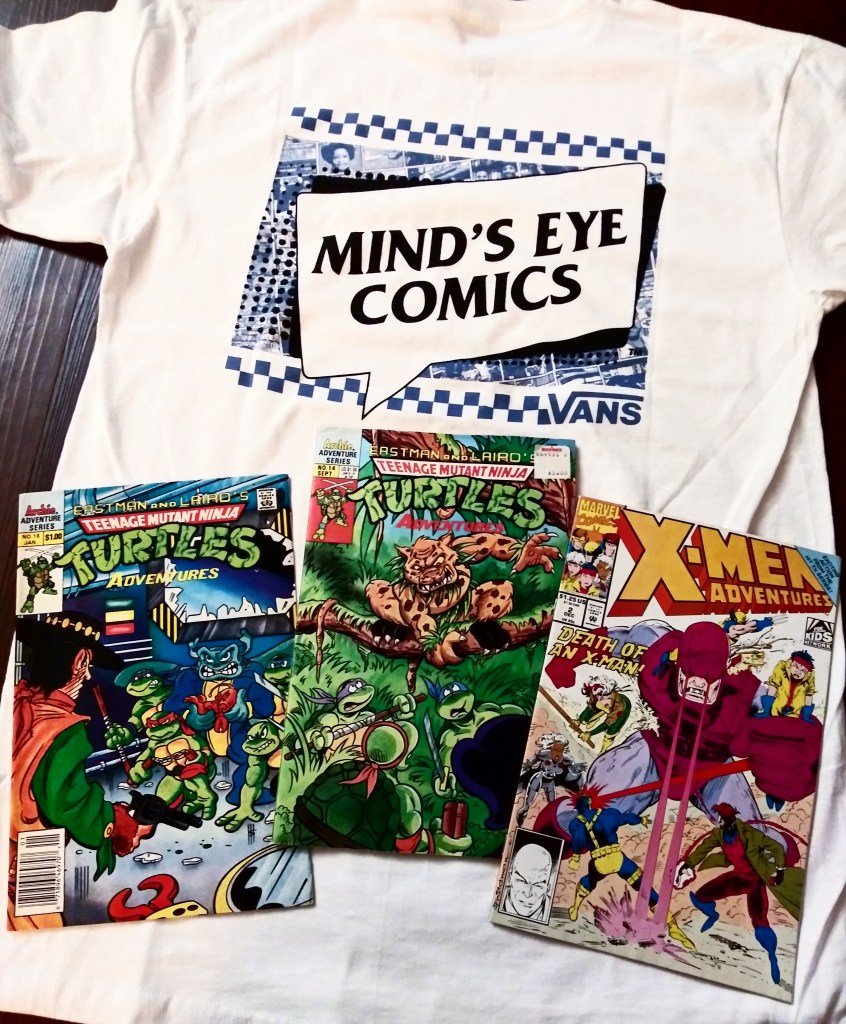
I was there last Monday, looking for nothing in particular, when TMNT Adventures #16 (bottom left) slapped me right in the face. OMG. That was one of the covers. I bought it and then ran home to scour eBay, finding the other cover I knew (#14). I learned that X-Men Adventures (a comic based on a cartoon that was based on a comic) existed, leading me to yet another cover I remembered.
I wanted these because I wanted to be able to say the first comic I ever picked up was Teenage Mutant Ninja Turtles Adventures #14, which came out in September 1990 when I was 5 years old. I got it at the local drug store on a spinner rack when I lived in Minneapolis.
I wanted these because I wanted to know what my earliest artistic influences were. What shaped me as a kid and gave me such a love that I obsess over these stories, characters and medium to this day.
Speaking of which: my Mind’s Eye t-shirt arrived, too. The comic I picked up when I was 5 put me on a path to make my own comics and have relationships with the comic community and shops like the one on this tee.
Some love fades away — and some love just never dies.
We have this thing where we think we’re the center until we can see the whole.
A few months after my mom died, I got three plastic tubs full of stuff from the time I was born until the late 2000’s. She kept a lot of me and for that I’ll be forever grateful; if there is ever a me museum, it will be entirely too thorough.
For a long time, human beings thought Earth was the center of the universe. (I’m sure there are people who still do and I just can’t even right now.) It wasn’t until we pulled back to see the bigger picture that we found we were wrong.
I think the same goes for our sense of self. We start by knowing only ourselves and, as far as we can tell, we are the most important part of our own everyday existence.
For weeks I’ve been going through this stuff, reconstructing my own timeline, and it’s helping to see the actual orbits of my entire life.
Like the Earth itself, once self-actualized, we get to recognize the awesome system that we’ve been a part of all along.
Jupiter pulls in debris before it can reach Earth. We have people who speak dearly of and defend us when we’re not around. Other planets and stars make themselves visible regularly, shining bright. Those people share our orbit — they’re our cheerleaders, our moral support, who remind us that they’re always around. We all have our constellations of acquaintances, and some of those burn out. We each find our own suns to rotate around.
And just as you’re accepting that you’re Earth, you make the realization that you’re also one of these other heavenly bodies to every other person you know. You’re a moon. You’re the sun. You’re a dangerous comet. You’re a shooting star.
I don’t know what I did to deserve the universe I got, but I do know that seeing my place in it from this vantage point has made me appreciative beyond belief.
There was once a scientist who spent his entire life trying to explain why our planet is 93 million miles away from the Sun.
The moment you figure out why that was a waste of time is when you accept and embrace your celestial roles in the infinite multiverse to which you belong.
Despite everything, there is something magical about that first inhale of near-spring air after a seemingly infinite span of bitter cold.
I’m not a person who believes that suffering makes a human better. I think that I will always struggle to varying degrees from the pain that I’ve been through and the pain that I’ve inflicted; I feel like a lot of people who have been through any kind of trauma can attest to that. What doesn’t kill you could have, and it’s hard to forget that.
We’ve been through a deep freeze as of late. Only over the past day or two have we been able to remember a temperature that isn’t actively trying to kill us.
When I took Marvel out today, she gulped the air through her big, wet nose like she had never smelled sweet oxygen before. We smiled together, and as much as I don’t want to admit it, there is absolutely something special about being able to breathe fresh air after surviving a winter.
More than just a season, the last year has felt like that isolated cold. Staring out the window, counting uncertainties.
Learning to breathe again — cautiously, optimistically — is the lesson that I needed today. And my dog, aware that I am helpless without her, is the teacher who shows me how.
There is something about a direct kind of love that is irreplaceable.
Last winter, I bought this long-sleeve shirt.
One of the first times I wore it was at a convention in Hastings, the very last one my mom came to.
She looked at my shirt and told me how beautiful she thought the rose was on it.
As far as I know, my mom was not a fan of anime. (That’s an assumption, but she had never expressed any love of Japanese cinema to me.) She had no idea what a Cowboy Bebop was and didn’t really have an interest in finding out.
But she really loved that rose.
And she always made a point to point out the things that she loved.
It made her a remarkable kind of joy to be around.
Among so many other things, I got my love for America’s Funniest Home Videos from her. (I named the first chapter of my first book after that very show.) It is one of the first things I remember watching with her and it was one of the last.
Like her, it lacked pretense. It clearly communicated what it was all about. It was fun and it was direct.
I miss that directness a whole lot right now.
We so frequently bend the frequency of our words in order to get to what we mean in roundabout ways. So many of us revel and wallow in irony, sarcasm, and outdated social contracts.
We need to tell each other how much we love those roses.
I’ve finally finished curating the essays I’m going to include in my upcoming collection, Time is a Solid State. I’ve received so many nice comments and messages from people who appreciate my writing, and reading my work from the past five years as a whole like this allows me to give a begrudging admission: I kind of get it.
But it also gives me a certain clarity about what I am.
I am not brilliant. I am not a genius, technical or otherwise. I am not an expert in any field or trade. I am, in fact, deeply flawed.
But I am a very good filter.
I have been exposed to exceptional people and extraordinary ideas. I am always learning and seeking and digging for the truths of human existence. The way that I aim my lens and then develop those thoughts and feelings with language is the unique thing I do.
To be honest, I both always wanted to do a book of my posts and also wasn’t sure if there was any material that was worth the paper. As I find myself having to cut so much away, I’ve realized that it’s all there and more.
I pour my everything into these words I share on the internet for free. Because of that, they find a way to continue to mean something.
I am a filter, a tool, that distills big ideas and enormous emotions in an attempt to hijack the normal state of online behavior and instill genuine connection, empathy, and understanding.
And if that’s not worth publishing with my name written on it, then I can’t think of a thing that is.
The lectures of William James have probably affected my life more than anything I have ever read. His pre-1900 thoughts on religion — the ideas of religion, the science of religion — have had an irreversible effect on how I see the world, secular or otherwise.
In one of my favorite sections, he draws up three basic rules that humankind should follow when dealing with divine intervention. The reason I love these rules so much is that they’re designed for the best of all humanity, no matter what you do or don’t believe. He posits that if we keep these rules in mind when dealing with forces we don’t fully understand, we would more fully understand one another. I completely agree.
So without further ado: these are the three simple rules for talking to God.
1. When a person tells you they have spoken to God, whether it be a dream, vision, or other form of communication, you need to accept that as a fact. It does not matter if you believe in God or not. The reason for this is because they accept it as fact, and the sooner you realize this, the easier it will be to navigate.
Secular people will argue in these situations by using factual information — things that are provable, things we can see and hear. What they fail to understand is that the person who heard God considers this conversation to be just as real as numbers or flowers or your dog.
It may not solve any arguments, but it will give you a better understanding.
2. The person who heard God may not, by any means, force another human to do something that God told them to.
As you can imagine, this is a big one. (Huge Christian atrocities, like the Crusades, could have been sidestepped by this one.)
For example, let’s say my friend Jordan had a dream, and in that dream, God told him that I needed to move to Japan. Jordan tells me about his conversation with passionate conviction. I hear him, understanding that he accepts this vision as fact. I now have the right as a fellow human being to thank him for sharing, but to also decline the relocation to Japan. Following these two rules, Jordan needs to respect my response.
Which brings us to the third and final rule.
3. If a person shares their conversation with God, and I independently decide that it makes sense to me, there is nothing wrong with making the decision to go with it, regardless of my beliefs.
Let’s continue my example: now, Jordan has told me that God told him I should move to Japan. Instead of outright discrediting it, I decide to actually consider it. The more I do, the more I find the move actually makes sense for me.
The third rule says that despite my reasons or personal beliefs, I can independently decide to listen to and follow any divine advice given by other people.
And that’s it.
I’m personally agnostic, which is the grayest spiritual area. Believers *know* what they believe, atheists *know* there is nothing to believe. Agnostics only know they are unsure.
The only thing I’m sure of is that being mindful of anyone makes this life more livable for everyone.
Not the house in this photo. Not any of the houses I grew up in.
The house that I am.
The older I get, the less the rooms make sense, and the more rooms I find there are.
One day, I’m dusting a flawless hanging light fixture. The next, distinct cracks start to spread over its glassy surface as memories I rediscover shift the entire framework and structure of the house.
Some mornings, I can draw the curtains all the way, open the windows up wide and bathe in seemingly eternal sunshine.
Others, I can’t find a window or door at all, and the house feels sinister, dark and haunted.
This house.
I fill it with so many things and words and people and whenever I think I’ve completely filled the entire house, finally, I find another room, an empty room, and I find more things and words and people to fill it.
I’ve poured gasoline in rooms and set them on fire, only to find them completely intact the next day.
I’m in a constant state of remodel. I’ve let people go into rooms that hurt them, and for that, all I can be is brutally, sincerely sorry, and hope to lock those rooms strongly enough to make them nothing more than historical sites on the property.
From my house, I see your house. I’m envious of your house. Of all the houses. But every morning I look out my window and see your house change, too, and I remember that you work on yours like I work on mine.
Of the many admirable qualities in a dog, their ability to truly live in the moment might be the one I’m most envious of.
This morning I was giving this girl a belly rub and I just marveled at her focused appreciation. She gratefully reacted to every scratch and snuggle, never once looking up to me to question when the session would end.
That’s the hardest thing about being human. We’re always so worried about when something is going to end that we don’t always allow ourselves to fully experience joy as it’s happening.
So I was driving down to Faribault this morning and thinking about an episode of I Love Lucy.
In this episode, Lucy and Ethel work as inspectors in a chocolate factory. At first, they’re doing just fine, focusing on each piece as they pass on a conveyor belt. The machine starts moving faster and faster and more candy than they could possibly inspect starts piling up, the audience (and Lucy and Ethel) eating it up.
I was thinking about it because I am the inspector and, in a delightful twist of irony, also the machine. I’ve been feeling overwhelmed at times and like I haven’t been processing things like I should, so I just keep putting things in front of me to do.
As I thought about this, I realized I had arrived in town and decided to take a further exit. There stood the Broaster, home of delicious fried chicken and homemade sides, and I simply lost my shit.
The day my mom died, after all the things that had to be done were done, we decided on the Broaster for dinner. And as I ate, it felt like I hadn’t tasted food in a month, and eating made me feel both good and guilty in the same bite.
The feeling drained from me as soon and as sudden as it had come down.
And as I wear my tired jaw, I’m regularly left to wonder how long this chewing will go on.