I’ve finally finished curating the essays I’m going to include in my upcoming collection, Time is a Solid State. I’ve received so many nice comments and messages from people who appreciate my writing, and reading my work from the past five years as a whole like this allows me to give a begrudging admission: I kind of get it.
But it also gives me a certain clarity about what I am.
I am not brilliant. I am not a genius, technical or otherwise. I am not an expert in any field or trade. I am, in fact, deeply flawed.
But I am a very good filter.
I have been exposed to exceptional people and extraordinary ideas. I am always learning and seeking and digging for the truths of human existence. The way that I aim my lens and then develop those thoughts and feelings with language is the unique thing I do.
To be honest, I both always wanted to do a book of my posts and also wasn’t sure if there was any material that was worth the paper. As I find myself having to cut so much away, I’ve realized that it’s all there and more.
I pour my everything into these words I share on the internet for free. Because of that, they find a way to continue to mean something.
I am a filter, a tool, that distills big ideas and enormous emotions in an attempt to hijack the normal state of online behavior and instill genuine connection, empathy, and understanding.
And if that’s not worth publishing with my name written on it, then I can’t think of a thing that is.
The lectures of William James have probably affected my life more than anything I have ever read. His pre-1900 thoughts on religion — the ideas of religion, the science of religion — have had an irreversible effect on how I see the world, secular or otherwise.
In one of my favorite sections, he draws up three basic rules that humankind should follow when dealing with divine intervention. The reason I love these rules so much is that they’re designed for the best of all humanity, no matter what you do or don’t believe. He posits that if we keep these rules in mind when dealing with forces we don’t fully understand, we would more fully understand one another. I completely agree.
So without further ado: these are the three simple rules for talking to God.
1. When a person tells you they have spoken to God, whether it be a dream, vision, or other form of communication, you need to accept that as a fact. It does not matter if you believe in God or not. The reason for this is because they accept it as fact, and the sooner you realize this, the easier it will be to navigate.
Secular people will argue in these situations by using factual information — things that are provable, things we can see and hear. What they fail to understand is that the person who heard God considers this conversation to be just as real as numbers or flowers or your dog.
It may not solve any arguments, but it will give you a better understanding.
2. The person who heard God may not, by any means, force another human to do something that God told them to.
As you can imagine, this is a big one. (Huge Christian atrocities, like the Crusades, could have been sidestepped by this one.)
For example, let’s say my friend Jordan had a dream, and in that dream, God told him that I needed to move to Japan. Jordan tells me about his conversation with passionate conviction. I hear him, understanding that he accepts this vision as fact. I now have the right as a fellow human being to thank him for sharing, but to also decline the relocation to Japan. Following these two rules, Jordan needs to respect my response.
Which brings us to the third and final rule.
3. If a person shares their conversation with God, and I independently decide that it makes sense to me, there is nothing wrong with making the decision to go with it, regardless of my beliefs.
Let’s continue my example: now, Jordan has told me that God told him I should move to Japan. Instead of outright discrediting it, I decide to actually consider it. The more I do, the more I find the move actually makes sense for me.
The third rule says that despite my reasons or personal beliefs, I can independently decide to listen to and follow any divine advice given by other people.
And that’s it.
I’m personally agnostic, which is the grayest spiritual area. Believers *know* what they believe, atheists *know* there is nothing to believe. Agnostics only know they are unsure.
The only thing I’m sure of is that being mindful of anyone makes this life more livable for everyone.
Not the house in this photo. Not any of the houses I grew up in.
The house that I am.
The older I get, the less the rooms make sense, and the more rooms I find there are.
One day, I’m dusting a flawless hanging light fixture. The next, distinct cracks start to spread over its glassy surface as memories I rediscover shift the entire framework and structure of the house.
Some mornings, I can draw the curtains all the way, open the windows up wide and bathe in seemingly eternal sunshine.
Others, I can’t find a window or door at all, and the house feels sinister, dark and haunted.
This house.
I fill it with so many things and words and people and whenever I think I’ve completely filled the entire house, finally, I find another room, an empty room, and I find more things and words and people to fill it.
I’ve poured gasoline in rooms and set them on fire, only to find them completely intact the next day.
I’m in a constant state of remodel. I’ve let people go into rooms that hurt them, and for that, all I can be is brutally, sincerely sorry, and hope to lock those rooms strongly enough to make them nothing more than historical sites on the property.
From my house, I see your house. I’m envious of your house. Of all the houses. But every morning I look out my window and see your house change, too, and I remember that you work on yours like I work on mine.
Of the many admirable qualities in a dog, their ability to truly live in the moment might be the one I’m most envious of.
This morning I was giving this girl a belly rub and I just marveled at her focused appreciation. She gratefully reacted to every scratch and snuggle, never once looking up to me to question when the session would end.
That’s the hardest thing about being human. We’re always so worried about when something is going to end that we don’t always allow ourselves to fully experience joy as it’s happening.
So I was driving down to Faribault this morning and thinking about an episode of I Love Lucy.
In this episode, Lucy and Ethel work as inspectors in a chocolate factory. At first, they’re doing just fine, focusing on each piece as they pass on a conveyor belt. The machine starts moving faster and faster and more candy than they could possibly inspect starts piling up, the audience (and Lucy and Ethel) eating it up.
I was thinking about it because I am the inspector and, in a delightful twist of irony, also the machine. I’ve been feeling overwhelmed at times and like I haven’t been processing things like I should, so I just keep putting things in front of me to do.
As I thought about this, I realized I had arrived in town and decided to take a further exit. There stood the Broaster, home of delicious fried chicken and homemade sides, and I simply lost my shit.
The day my mom died, after all the things that had to be done were done, we decided on the Broaster for dinner. And as I ate, it felt like I hadn’t tasted food in a month, and eating made me feel both good and guilty in the same bite.
The feeling drained from me as soon and as sudden as it had come down.
And as I wear my tired jaw, I’m regularly left to wonder how long this chewing will go on.
I was there at Fan Fusion, which wasn’t my first comic convention ever, but my first comic convention as a real comic book creator.
I had written, drawn, and produced my debut issue, The Flying Squirrel #1, with a plan for a 5-issue series I would one day collect in a full-color graphic novel.
I just had to make it through this weekend first.
I did okay, but I didn’t expect the moment that would change the way I talked about myself forever.
Some of you are very familiar with tabling at conventions. Even more of you are familiar with sales in general; the difference being as a writer or artist you are also your product.
Ashley Maypole, the Flying Squirrel, is an alcoholic comic book writer who starts dressing up like his own character in order to get his real life spark back. The concept wasn’t a stretch, but also not strictly autobiographical. At the time of Fan Fusion, I was almost eight months sober.
I was repeating Ashley’s story to anyone who would stop by my table and listen. I got a lot of great feedback, made a few fans and even sold a handful of books (which gave me hope as a first-timer). But one guy threw me for a loop.
I explained the concept and without missing a beat he said, “Thank God that’s just a character you’re writing and not your real life. That would be a pretty shitty way to live.”
I absolutely froze. I don’t know what my face did but it was definitely paralyzed. I said no actual words and fake-laughed until he just walked away.
I didn’t get it. I wrote this story BECAUSE I wanted to normalize it, to be able to talk about it. That’s why I wrote all of The Weirdos. And when the time came — I choked.
And I’m glad I did.
It made me do some more soul-searching. I kept digging until I found that level of comfort with myself that I thought I had, but still had some work to do.
And hopefully if you’re finding some things still hard to talk about, you’ll find comfort in the idea that you can get there.
I had mentioned earlier this year that since I started truly blogging and writing digital essays, I had scribbled and typed more than 60,000 words over the past few years.
That’s a lot of words. That’s a novel amount of words.
These posts are easily what I get the majority of my responses and messages for; they’re the most-requested pieces people ask to share and for me to find (Regular inquiry: “Do you remember what that one was called…?”).
Having a website is great, but there’s just so much content that it’s hard to go back and find the thing that maybe spoke to you or made you think or feel.
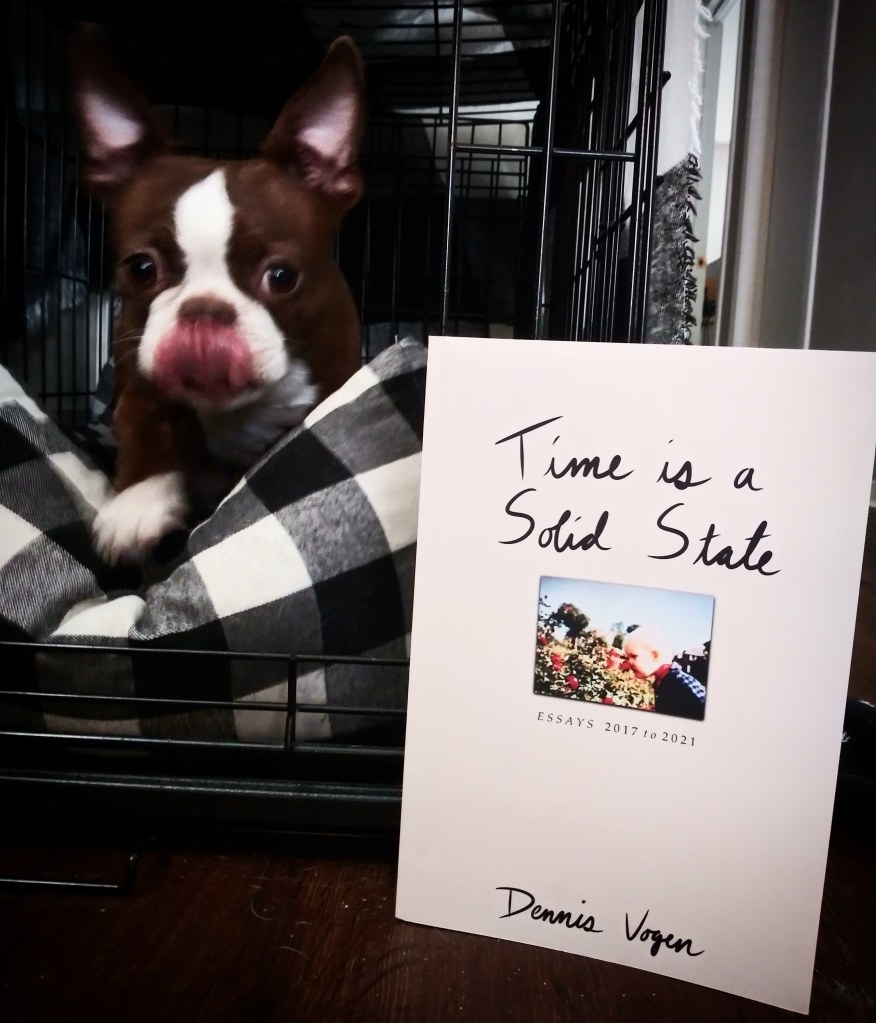
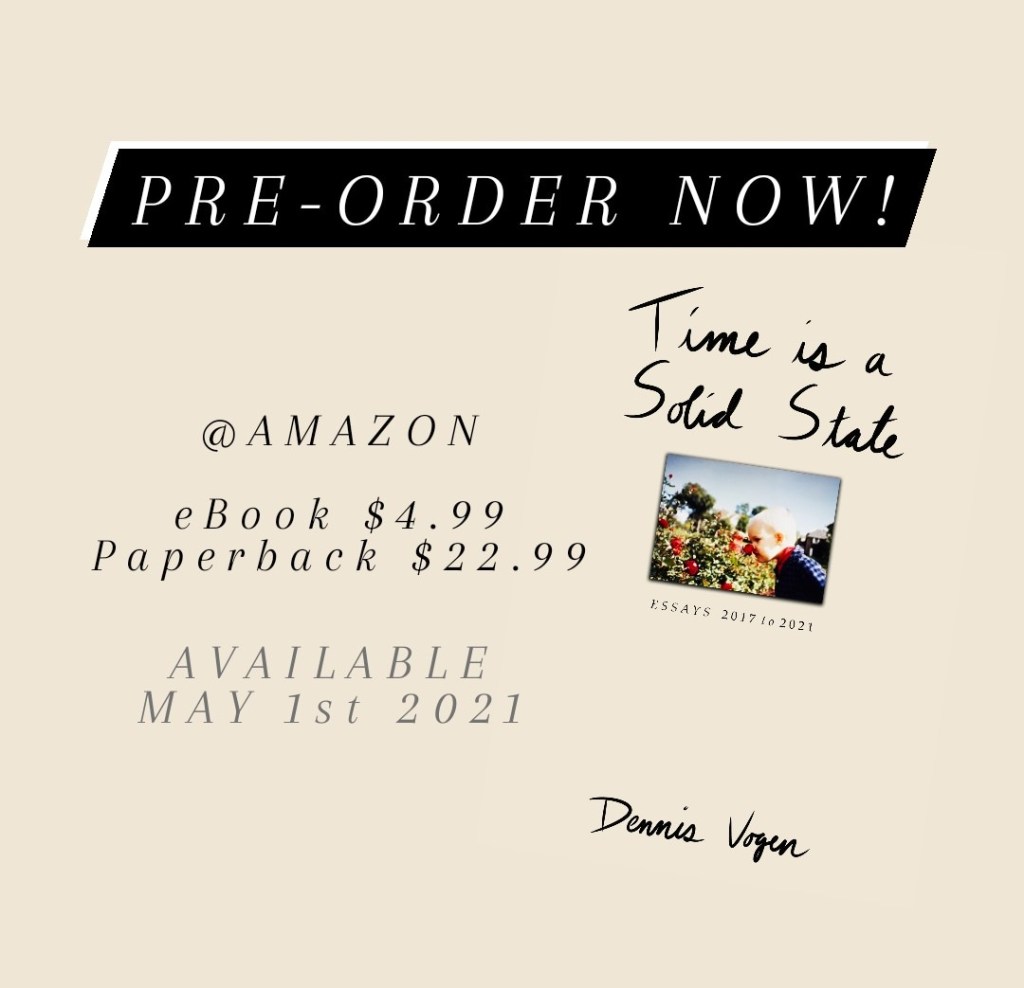
So I’m beyond happy to announce Time is a Solid State, my first collection of essays.
It’s not just one thing: yes, some of the essays will be verbatim reprints of their original form — but others have additional parts that were lost, due to space or time constraints. There are also brand new pieces that no one has ever seen, and even more unique content specifically created for this book.
In fact, there’s essays I wrote and never posted because I was worried about the comment section. The most beautiful thing about a book is that there is no comment section.
This is an absolute experiment for me; I don’t know who the target audience is for it (which, let’s face it, is not my forté in deciding when I’m creating anything). But it’s something different and I really want a paperback version of what has basically been my journey over the last three-plus years. It’s less formal than a memoir. It’s an open-faced digital diary.
My goal is to open pre-orders in April (which I’ve never really done) and we’ll see where this goes from there. If even one person besides me is excited for this, then I’m ecstatic.
All my love. Hope you’re hanging in there, squirrel.
P.S. This doesn’t interfere with any of my other projects; this is a cherry-on-top book.
“To fight the empire is to be infected by its derangement . . . Whoever defeats part of the empire becomes the empire; it proliferates like a virus . . . Thereby it becomes its enemies.” – Phillip K. Dick
I didn’t know how it phrase it as eloquently as Dick, but this is what happened to me.
This is what has happened to a lot of us. This is what has been happening to humankind since it could throw its first stone.
After the election four years ago, I was a lot of things. Angry, I would say, especially. It was reflected in my words, in my actions, in my posts.
Supposing I had the moral authority and ethical high ground, I felt it a duty to point out the many wrongs of the individual, the group, and the overall state of things.
And I saw the world expressing itself just as I was, in equal and opposite reaction.
It was ugly.
And it wasn’t until I took an examining look in the mirror that I realized I was taking on the traits of the “enemy” I was adamantly trying to vanquish.
It took years, but that realization took me down a more rewarding path.
I started using my voice and my words differently. Instead of over-sharing the same news articles or videos, I started to more fully understand the brilliance of subtlety and metaphor. Instead of seeking to strike down anyone who I saw as an opponent of truth or kindness, I strove to try to lift them up to a place of understanding (to various levels of success and failure).
Most duly: I decided that if I came from a place of decency, empathy and compassion, and I was able to admit when I was wrong or saw something in a new way, then I would always be successful as a writer and, more importantly, as a person.
Again, I failed. A lot. I got into passionate discussions and shouting matches. Feelings were hurt on all sides.
But every time, I had my North Star. I had that place in the sky to turn to when I lost my way.
And I just wanted to thank you for helping me find it.
Some of you have been patient with me, and surprisingly supportive; even, and especially, when I didn’t deserve it. I’ve been engaged in so many conversations that have helped me be a better dude in general.
So thank you.
And I hope we can become like one another, in a better way, once again.
People love to say a person “passed before their time.” What few like to admit is that every person dies exactly when they were going to.
Everybody gets the same amount: exactly one life.
Time is a solid state. From the beginning of time to the end, you can pick it up and read it, like a history book. It happens simultaneously, meaning you can turn to whatever page you want to, whenever you want. That means that everything that is going to happen to you has already happened — and there is nothing you can do about it.
This isn’t a religious or spiritual idea; it’s rooted in objective fact. You are going to die, and you are going to die in one specific way.
Before you think I’m screaming from inside the blackness of the void and turn away from me — read on.
Because time is a solid, physical state, it means that you can feel any part of it at any time, using whatever means you have at your disposal.
For example, this photograph.
I don’t remember this moment. But, somehow, I can smell this rose. I can feel the soft pedals wrapped around my nose. I sense the muscle pulling in my young back as I lean in for the encounter.
It’s just as real now as it was then.
Something I do remember vividly, however, is my mom. Every day.
And because of this, I can feel her arms wrapped around my back, refusing to let me go for just a few more moments.
I can feel her kiss my cheek before she leaves, knowing that I’ll see her again soon.
I can hear her absurd, infectious laughter as I feel her slap my leg because I just said the thing that I thought would make her smile the most.
I feel her hand in my hand at the various times in my life that I just needed to hold her hand.
Time is a solid state; and that knowledge is a tool in my fight for keeping my head above the water and seeing it as an entire picture.
I just finished doing a read-through of The Invisibles, Grant Morrison’s hugely-influential, extremely 90’s comic book series about a secret war between those who fight for freedom and those who fight for control; for truth and for lies; for subjective good and for subjective evil.
It operates under the question: what if every conspiracy theory is actually true?
As I tagged along with this ragtag cell of psychic operatives, I simultaneously started thinking about the 90’s itself, and the paranoia it successfully stoked, most notably in series like The X-Files and films like The Matrix (whose creators have cited The Invisibles as a major influence).
These works were all based on a singular theme: never stop questioning your reality.
Which, at its core, is the human theme. There isn’t anything inherently unhealthy about asking questions.
Or is there?
We’re now a few decades along on this particular path where paranoia and pop culture merged in a very significant way. Groups like QAnon have preyed on severe, indoctrinated distrust, and folks who were taught that the truth is out there are now determined that the truth is anywhere but what is right in front of their face.
The stunning revelation here is that in almost all these examples, the heroes are trying to prevent the end of the world as we know it, and the only way they can do it is by exposing the “truth.”
But what happens when the asking of questions becomes the final stage? What happens when a person decides that there are no real answers or, even worse, there are only subjective answers — the only thing that can be right is the thing that I believe to be right.
Well, that brings me to my conspiracy theory.
My theory is that people refusing to accept objective truth isn’t the way we’re going to save the world. In fact, it’s quite the opposite: the rise of conspiracy theories will be the end of everything we know.
(So what I’m asking you is this: please help save the world with me.)