I finished watching After Life tonight (which I had talked a little about yesterday). It’s a simple joy when, instead of learning a new lesson from something, it just reaffirms a belief you’ve known all along.
One of the things that Tony learns is that sharing the life of someone he had loved and lost is the surest way of making certain they live on.
I knew from the day she passed that all I wanted to do was write and talk about how wonderful my mom was for as long as I can, because I knew that her love and wonder was something that could make a person’s day today, no matter where she happens to be.
Finding wisdom in the opposite of lessons is worthwhile, too.
Tony tells another character not to wallow, because wallowing is easy. You can find yourself addicted to grief and only finding comfort in the sad, ungrateful and uncomfortable.
You can also find yourself lost in ignoring that grief by any and all means, in being busy and imitating what others know as you being okay. That’s what I’ve been doing, and I think I need to learn how not to wallow, but to be able to tread in it, to let myself feel it around me.
To watch a show which has the singular purpose of dealing with the idea of being okay and what okay means to anyone anyway has been a nice way to dip my toe in.
Anyway, I hope you’re hanging in there, claws and talons and all. Give the person (or animal) next to you a hug. And don’t turn down an opportunity to dance when you find yourself presented with one.
I was brainwashed as a child to love and deeply care for my planet. And I couldn’t be more grateful.
If you’re my age, you might have been, too.
So how did this happen?
If you were a child of the 70’s and 80’s, you lived through what many consider to be the Golden Age of Saturday Morning Cartoons. It was the Wild West, lawless and a goldmine for the adults who were throwing the party: commercial after commercial directed squarely at children ran between shows that were also designed to be half-hour-long commercials. It was a candy-colored capitalistic dream.
Until someone at the FCC said, “Wait. Our kids are real stupid and all they want to do is just literally buy stuff. Is… is this bad?”
It’s not great.
So along came the Children’s Television Act of 1990. It required broadcast stations to air educational programming for a portion of every day, particularly when kids were likely to be watching.
Problem solved!
Kinda.
Since America is very much so a place where people like to pretend to care about children but definitely care about money more, they had to find loopholes. And they did.
They started making the cartoon advertisements about stuff that was important, in an effort to kill two birds (make kids smarter, make more money) with one enticing stone.
The most notable example is Captain Planet, which has an amazing backstory (look up Toy Galaxy on YouTube for a great historical account on the Ted Turner-backed project, and a more in-depth look at how Saturday Morning Cartoons changed).
Since the shows themselves now contained “educational content” (which became a subjective phrase, and lacked accountability), they were free to also sell stuff to children — like Captain Planet toys.
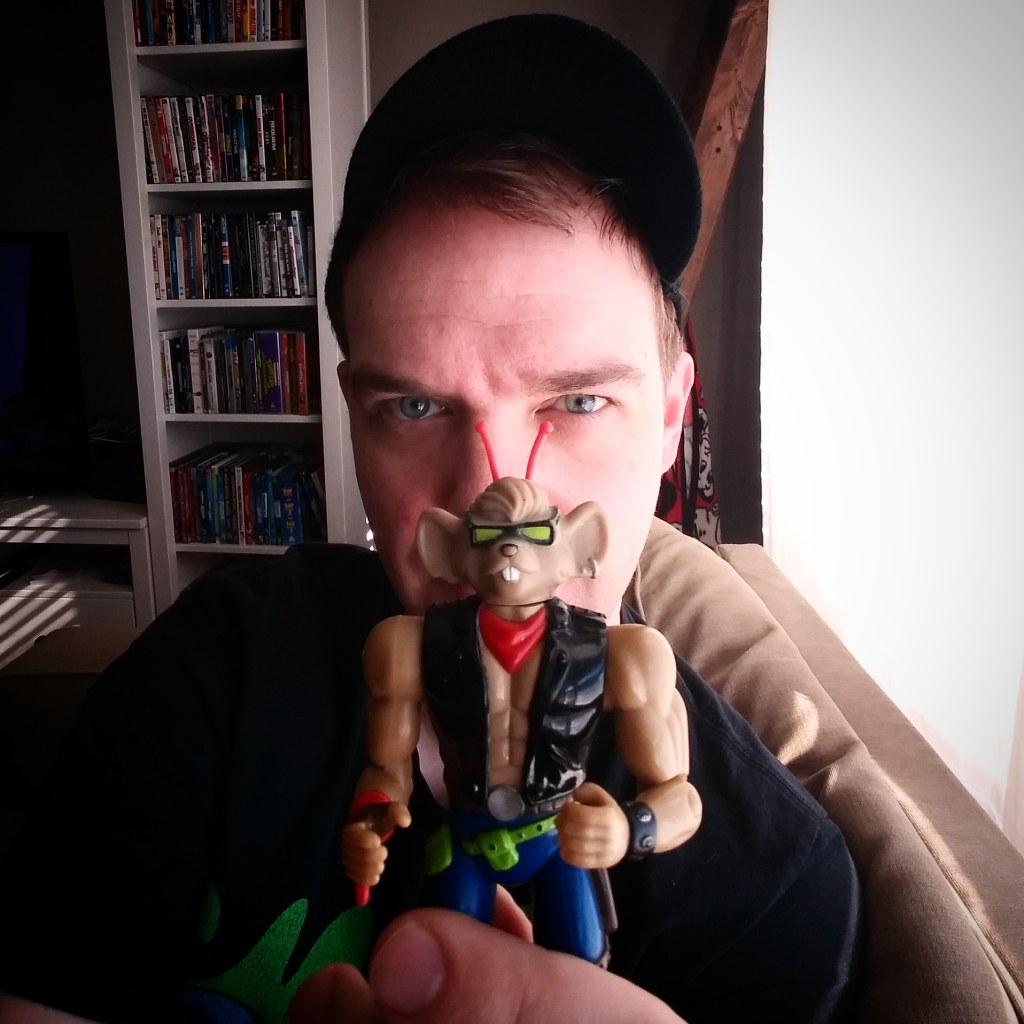
This dude I’m holding is from a TV show called Biker Mice From Mars. How in the heck is a show about three person-sized alien mice, who drove motorcycles that definitely caused emissions, about anything but selling toys? Well, they’re refugees from Mars, which was attacked by another group of aliens who stripped the planet of its resources. The Biker Mice are trying to stop the same thing from happening on Earth.
Now this is the best part: it backfired.
We actually paid attention to this planet Earth propaganda, and it made some of us environmentalists, even accidently or subconsciously.
And you have a bunch of old people who are upset that we care about our planet so much that we want to change the way we live — and they don’t even see the irony that it’s their damn fault.
They wanted me to buy Biker Mice From Mars toys so bad that they didn’t realize I’d actually want to grow up to be one.
All of this to say: Happy Earth Day. I hope you love this planet as much as I have been brainwashed into loving it. I hope you see its unlimited potential, its boundless beauty, and realize how unique its existence truly is.
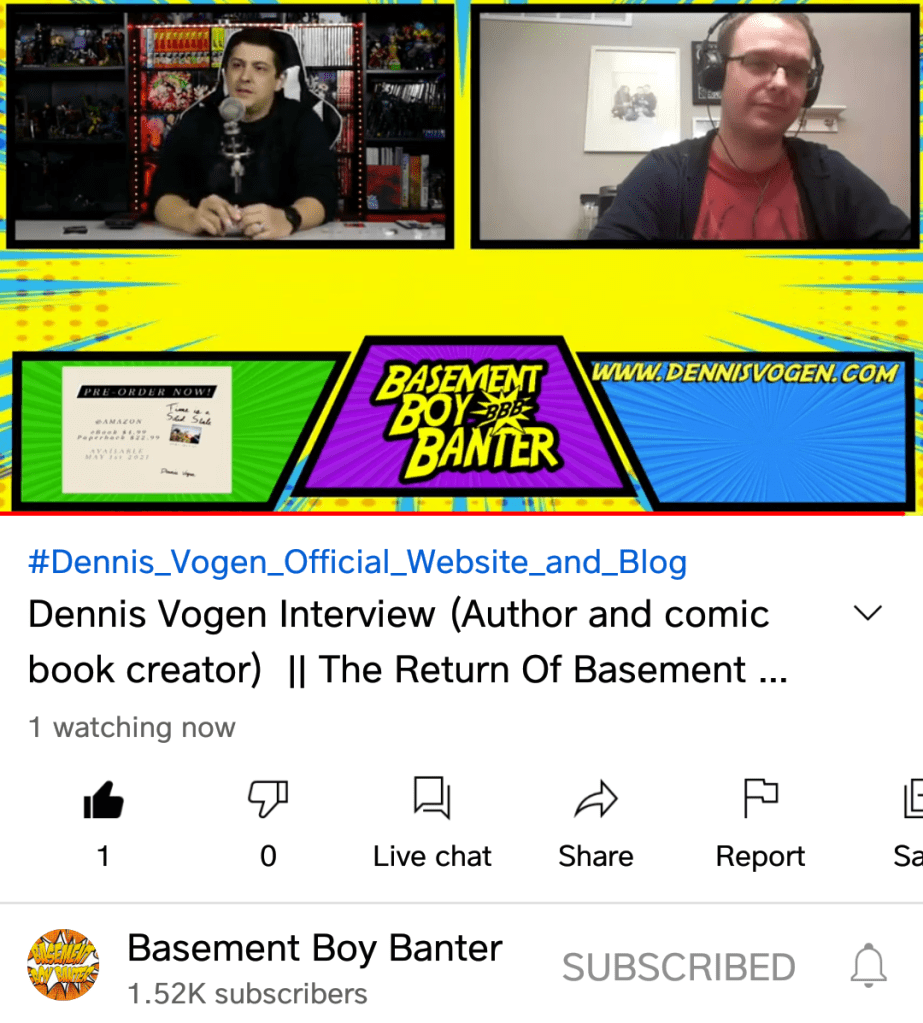
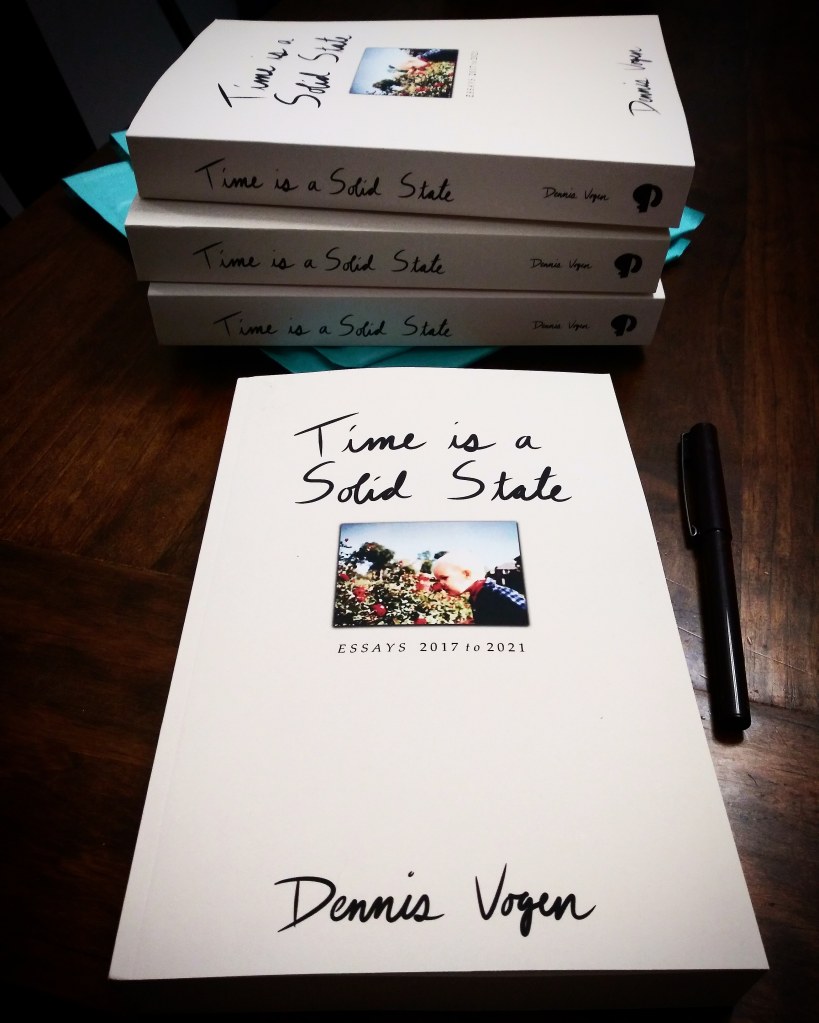
Five years after I was the first guest co-host on Basement Boy Banter, both the show and I return, this time to promote my new collection of essays, Time is a Solid State.
Like my book, our conversation covers a wide lens of topics, from the multiversally nerdy to the intimately personal.
This morning I was cleaning out my phone (it feels five pounds lighter without all those Baby Yoda memes [remember Baby Yoda memes?!]) when I came across something that I obviously saved for a reason. It reads:
“If you’re ever scared that you’re a bad person, remember that bad people don’t care about being better.”
This is an important thing to remember that my brain is very good at making me forget.
Instead of making excuses for anything bad I have done, I choose to explore the reasons. I don’t know all of the reasons, and discovering them is a painful (and sometimes shameful) process.
I know now that many of the boys and men I grew up watching and emulating were not good examples of human beings. I did not always know that (and again, that’s not an excuse) and I think there comes a point when we have to accept that how we grew up cannot be the sole reason for the way we think and behave.
I say this as an introduction to a grander idea: I think, right now, it’s pretty easy to look around ourselves to see who is trying to be better.
And I truly believe that is what makes them good people.
For all the people who are clinging to their pasts, to our country’s past, to humanity’s past, to outdated religious and moral codes, there are so many others who are listening and changing and want you know there is room in their hearts for you, no matter who you are, no matter what you’ve done (at the acknowledged risk of sounding like a Backstreet Boys song).
I’ve been checking in here and there during this process of loss (generating a mutual field of reflection), and I guess I was wondering if it’s okay to check in right now.
Cool?
Cool.
On my way to work today, I realized that yesterday marked six months since my mom exited stage left. I can’t believe I missed it, but I can. The entirety of time is just two push-pins stuck in the wall, and I am wobbling across the piece of yarn stretched between them.
Thus far, I’ve been able to transcribe what I’m feeling through carefully chosen words, which I feel like I do more for your sake than mine. I feel like if I make what I say sound pretty, I won’t burden you with what I say.
I’m not going to do that today.
The last six months have been the loneliest I have ever felt in my entire life.
That isn’t so pretty.
I know this isn’t anyone’s fault. People who assign cold, clinical words to very messy human emotions would call this “part of the process.” Those people are awful at parties and would do better to call it as it is: it just sucks.
I’ve lost things in the last year — a job, a car, my other livelihoods — that in any other year would have been devastating and terribly difficult for me. They haven’t even been able to register in a meaningful way, because I’m not able to feel their significance in such stark relation to real loss.
Six months in, I haven’t been able to grieve in any way that feels like progress. People move fast, the world moves fast, life moves fast. I’m afraid of being left behind, so I hammer in these posts on the side of the road and I keep moving, too.
I know there are days coming soon that will give me time to reflect and absorb and expell. I’m looking forward to them like one looks forward to the dentist.
Which is appropriate. The last six months have felt like a waiting room.
This is going to be a loaded post. I give you this warning ahead of time as a courtesy: if you’re having a nice day, just scrolling along, having funsies, I encourage you to continue on ahead unimpeded. Have a good one.
If you’re still here: let’s do this. There is a lot to unpack here.
My opening thought is not my own, but it inspired me to begin.
There is a subset of folks who keep repeating: “If you just comply with the police, you will not get shot.” (Which is an inherently false statement, but let’s pretend for the sake of my next argument that it’s true.)
If this statement is correct, it means: there is a group of people in this country that can make you do something, and if you do not do what they say, they can shoot you.
That is the antithesis of freedom. This is the opposite of being free.
On Wednesday, a 61-year-old white man in Hutchinson assaulted an employee at Menard’s over their mask policy. Menard’s called the police, and the man not only evaded — meaning not complied with — officers, he actually dragged one with his car and hit them in the head with a hammer.
To absolutely nobody’s surprise, he was taken in alive, where he continues to be alive, as far as blinking and breathing is concerned.
I know there is another, related group of folks who don’t believe in masks. Yes, the same people who believe that we should comply also do not want you trampling on their mouth freedoms. Yes, the same people who understand that most businesses are privately owned, and agree that if you don’t wear shoes or a shirt they are also legally allowed to not let you participate in their installation of capitalism.
In fact, there’s an alarming amount of people who believe that masks are a social experiment.
Let’s go ahead and say they’re right and it is a social experiment. Why should we do that? Because it was a successful one.
It showed which of us were willing to make a small sacrifice for our fellow human beings; which of us were willing to make it but were going to complain the entire damn time; which of us were going to refuse to make it based on their subjective opinions or beliefs; and which of us were going to actively make things worse for their fellow human beings.
It showed all of us all of that, and there is no going back.
So why am I bouncing around these topics with no apparent connection?
Because each highlights how flawed and hypocritical we are. Each is an example of biases and beliefs that focus on the self as opposed to the community.
These things have always been a part of us, but we’ve been through a year that took spotlights and headlights and laser pointers and lit the bad stuff up like dynamite with a bad Instagram filter.
It’s hard to see and figure out what’s real anymore.
I just know that I wake up every day with an overwhelming sense of dread. It’s hard to get up sometimes for a wooden chest full of reasons. I don’t think I’m alone.
But I tap into the things that keep me going. My dog. Writing. Family. Friends. Music. Superheroes. YouTube. Nostalgia. And I don’t think I’m alone there, either.
And I try to remind myself that all of us, every morning, are just rebuilding ourselves up again, like Lego sets on a loop. We start with nothing. And we’ll be nothing again tomorrow. And we’ll be so many somethings in-between.
We’ll contribute to one another. We’ll add bricks of different colors and emotions and ideas to everyone we meet. We build ourselves up, yes, but we build each other up, too.
And as we see people hoard their blocks more and more, we see how that affects us all. It makes us lesser. It makes us less colorful, less interesting, small.
I write to add blocks to your life.
I listen to and care about you to add blocks to mine.
We can build an infinite amount of worlds in our head in which to live. Sometimes we create them as a means to escape, sometimes when we create them we’re returned a massive amount of guilt, and oftentimes these worlds do both.
This is going to be a deeply personal essay about something I’ve never really talked about before, partially because I didn’t know it was something I had to talk about.
This week’s episode of This Is Us is a must-watch, and it deals with subjects such as race and family in a very intimate and powerful way. This Is Us is an important show in our home, so I do want to warn you: I use moments from the newest installment in this post, and I don’t want to spoil it for you if you haven’t seen it yet. So maybe come back later if that’s the case.
The episode revolves around a conversation and relationship between Kevin, a white male, and his adopted brother Randall, who is Black. In explaining how it felt to be adopted, Randall uses a term I was not familiar with: “ghost kingdom.” A ghost kingdom is a place you create in your mind to imagine a life that is different than yours. In Randall’s case, he imagined a life in which his parents were Black, and not his adoptive Caucasian parents.
I did not know why this concept resonated with me so profoundly, immediately. I am not adopted. I don’t have any siblings of a different race.
But they went on. Kevin admits that he was jealous of Randall’s otherness: the fact that he was adopted, and that he was Black. He felt those things made Randall special, which causes Randall to tell it as it is: he did not want to be special. He wanted to blend in. He wanted to be normal.
And then I got it.
My parents are deaf. I am not adopted. We are also white, so we have that outer privilege that I recognize. But growing up, I could not help but be “other.” I could not have a conversation in public without attracting the eyes of everyone around me. I had to do things that kids with hearing parents did not have to do, or even think about.
“But that’s special,” you think. I didn’t want to be special.
I wanted to be normal.
I often imagined what my life would be like if it were “normal.” How different it would be. As an adult, I still feel guilty about these thoughts, about the ghost kingdom I would inhabit, and it never occurred to me that maybe other people did this, too.
I didn’t expect to find it in a fictional character dealing with a very different life.
As an adult, I cherish everything about my family. I clearly see how special it is, how it shaped me, how it made me see the world like I do. It gave me a language and a community that I may never have had otherwise. I have experiences that very few other people on this planet have or could have. And I realize that this uniqueness is extraordinary.
But as a child I resented it. As a child, you’re selfish and you do want to blend in, to be as normal as possible. You don’t want everyone staring at you as you try to ask your mom a question. You don’t want to have to deal with every comment and question, just for having the family that you do, just for deciding to do something “normal” like going out to eat.
Do you know how many times I’ve been asked if my parents can drive a car? It might sound funny to you, but it’s one of the most-asked questions I get, and it infuriates me even to type.
If there’s a point to what I’m saying, it’s this: we create these places, these ghost kingdoms, not because we’re ashamed, but because we have to. We have to imagine that other world to give us the perspective we need in this one.
I’ve shared this story before, but when I was really young I once threatened my mom. I told her that I was going to tell everyone she was mean. She, taking absolutely no bullshit from this blonde-headed little ass, told me that was fine, because they would take me away and I would get a new mom.
My brain immediately imagined a world without my mom, and the insurmountable fear and instant regret shut me up and brought me back to this one.
If I had to choose my world or a normal one, I would choose this one, every time.
I always knew that in my heart. Now I know it in my head, too.
Since the beginning of superhero comic book storytelling, a recurring theme, explored over and over again, has been the hero’s apparent entitlement over what the rest of us recognize as vigilantism.
Sure, in general, superheroes are here to protect and serve.
But shouldn’t they be held to the same rules and laws as the rest of us?
Or are they above them?
In Chip Zdarsky’s current and absolutely brilliant run of Daredevil, he takes the idea even further: after Daredevil, while on patrol, accidently kills a man he considers just another thug, he turns himself in. Matt Murdock, his alter ego, is a lawyer who is constantly reckoning with what he does as Daredevil and what he believes is morally right, as a lawyer and a Catholic and a human.
Daredevil (to protect his identity, the superhero is the one on trial) is charged for his crime and is, to this day, serving his time in prison.
And still he questions if it’s not enough or if it’s too much.
Daredevil, unquestionably, is a hero. He has saved countless lives and has one of the strongest moral codes in comics.
Matt Murdock, unquestionably, is a human, who makes human mistakes and acts, by all accounts, like a human does.
I’m not talking about this lightly today.
We live in a society in which death is used as a currency. If you’re willing to sacrifice your life for any reason, you’re automatically considered a hero, regardless of what you do with your life. Conversely, if you’re willing to take life, a different kind of value is placed on you entirely.
My take has always been that no life is worth more than another’s. Every human has one right, and that is the right to be.
And if one is to enforce any rule or law, then one must also be beholden to it — if not in comic books, then in our very real world.
So, my giveaway didn’t go as planned: I didn’t get a single new review on any major sites like Amazon. Instead of randomly choosing a winner, I just handpicked some people who have been consistently supportive of me and my work (and who I think would dig getting a thing in the mail) and I sent them a copy of Time is a Solid State, on me (some of you have already received yours!).
I can’t do a lot, but I can show my appreciation for all of you who keep me going and remind me of stuff I need to know. I’ve always tried to, and I’ll always try to.
All my love.
(And remember: Time is a Solid State officially comes out in three weeks, on May 1st, which is totally coincidentally my birthday!)
This was a really fun one to do. Sometimes it just feels good to make something, as opposed to constantly be working towards a goal or multiple goals or all of the goals.
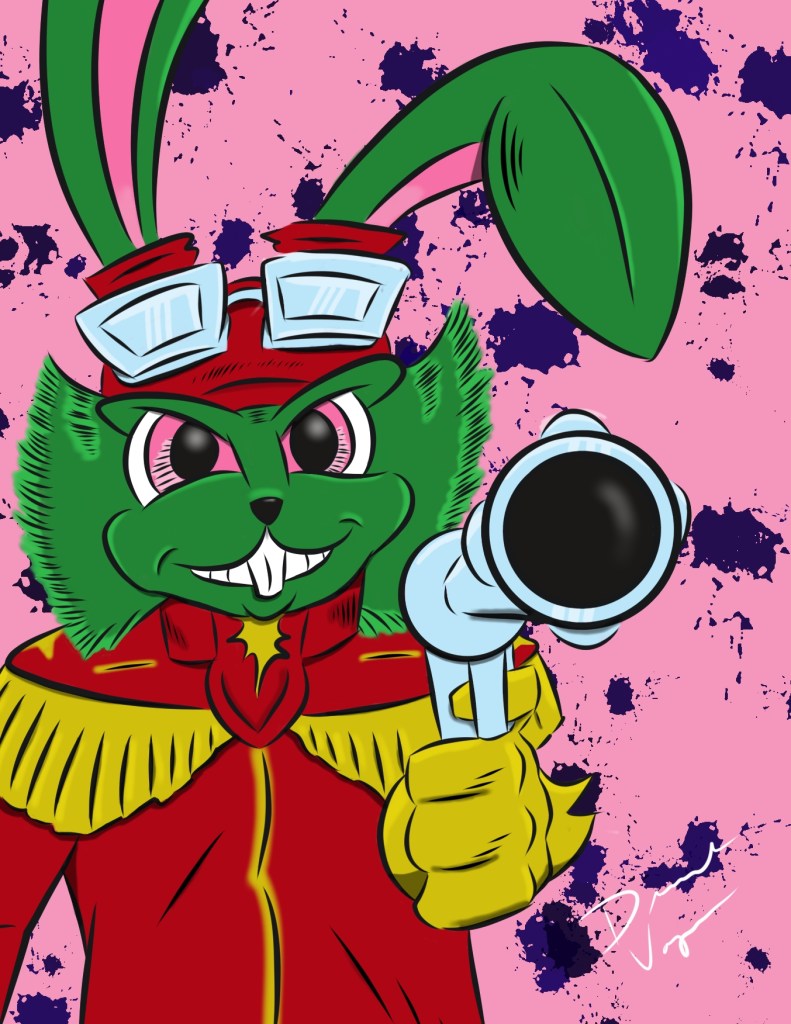
I spent my day off watching all 13 episodes of Bucky O’Hare, a cartoon that came out when I was six years old.
It is really refreshing to watch something from when I was a kid where the hero has somehow stood the test of time, no if’s, and’s or bun’s (because he’s a bunny, don’t act like you don’t come here for the puns).
For example, he believes in every person (or, in his case, every talking animal who are people where he’s from). There’s an episode when a shady alligator wants to join his crew, and his existing crew profiles the shady alligator, telling Bucky that it is not a good idea to hire him. Bucky tells them that everyone deserves a chance and he hires the shady alligator.
It absolutely backfires and the shady alligator ends up being shady, but the idea that we shouldn’t decide who someone is until they show us who they are is just one example of Bucky’s golden character.
In another episode, they encounter an octopus and the crew is uncomfortable with the fact that he’s an octopus (for some reason that isn’t elaborated on).
Bucky responds: “Why? Everybody’s got to be something.”
And ain’t that the truth.
He’s brave, and he’s loyal, and he’s smart, and he’s honest, and he also fights to save his people from slavery. His words and actions aren’t dated, because his character is based in classic morals.
Also, he is adorable.
Anyway, hope you like my drawing, please feel welcome to put it on your fridge. Hope your weekend is absolutely swell and I’ll see you back at work tomorrow.

 The Den