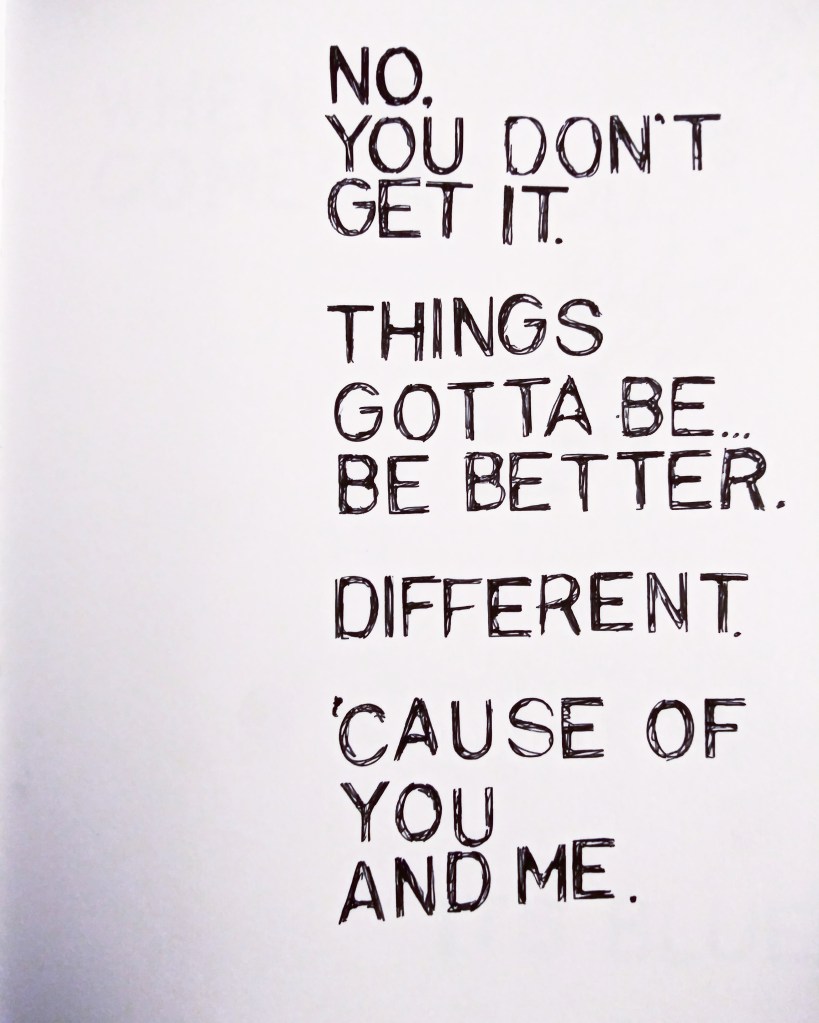
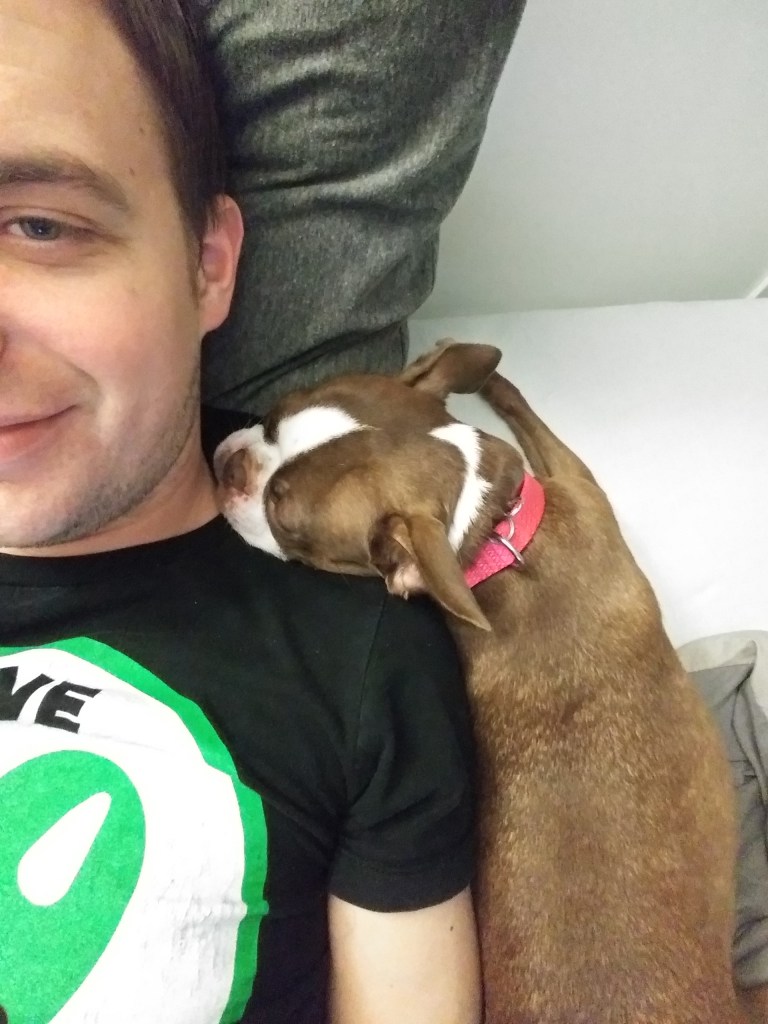
Art, doing its thing, which is nothing or everything depending entirely on you.
April 28th, 2019
Art owes you nothing.
If you find light, or find hope, or joy or peace or love in art, ultimately that’s on you.
Similarly, if you look at a work of art and it pisses you off, or deeply upsets you, or makes you angry or sad or indifferent — that is also all you.
I say this because art is what you make it. Yes, the artist has ideas and intent and works within or without a structure, but how art is perceived is only determined by one thing: you. And I feel like people have put too much responsibilty in artist’s and writer’s hands for things that they, in the end, will have no control over.
Which means that the observers of art need to learn how to take responsibility for themselves, and their role in the world around them. They need to be the change they want to appear and be the light they wish to see. They need to stop pointing their fragile fingers and put those hands to work.
Because, when all is said and done, art owes you nothing. And we owe it everything.
I just finished reading all ten volumes of Neil Gaiman’s The Sandman.
This will be a long post, so I’ll see two, maybe three of you down there at the end.
Rarely in your life do you experience a work of art in which you are changed and you can never go back; you can’t forget and you will always remember. Sandman is one of those moments for me.
I bought and tried reading the first volume many times, in my twenties. I’ve read a lot, if not most of, “the classics”; critically-hailed graphic literature like Watchmen, and I never had any problem with reading or understanding them. Or any books, really, for that matter. But Sandman would always elude me, or make me feel lesser. And I found out it was because I just wasn’t ready.
But this last time, I was. I had to be who I am now in order to travel down Morpheus’ path with him and have it mean anything. The book is about change and purpose and goodbyes and I had to figure out what those things meant to me on my own terms — by living, by creating my own art — to feel the echoes of Gaiman’s words so deeply and fully. And I did, and I do.
Sandman is not easy. It is hyper-intelligent and super-literate, deeply sensual and darkly erotic, it’s romantic, it’s horrifying, it’s hopeful, it’s terrifying, and it’s filled with more throwaway lines about the most important pieces of life than I have ever seen put together in one place.
And it’s about dreams, which are essential to me. I’m very glad I wrote my own book about dreams before I read Sandman. Because I found the gaps I dug and the bleeds that all humans feel without any literal influence. And that was rewarding in itself.
Anyway, this story changed me. For the better. I just realized a longer post is in me and a longer post would do it no more justice. So read it. And if you don’t: then just dream it. And know that everything changes and nothing really ever goes away.
This morning on the way to work, I pulled over to help two men who were trying to push a woman’s car out next to Crystal Lake. They were decked out in work gloves and thick boots; real men’s men. I feebly asked if they needed help; they said it couldn’t hurt.
The woman, who had front-wheel drive, wasn’t spinning in ice; she was in the ground, turning up thick mud. We pushed a couple times, and nothing was happening. I didn’t want to sound stupid, but I had an idea: had she tried driving forward at all? They all looked at each other and said it was worth a try. So, with a new plan, two tries later she pushed forward, pushed back and she was free, and I was back on the road to work.
Moral of the story? Never assume that everyone around you knows more than you do, and never underestimate your value in any situation. You can always help.
My entire life, I’ve been told that I speak too much, that I use too many words and that I talk too fast.
For a lot of my life, I was told to “fix” those things for miscellaneous reasons.
It wasn’t until I learned to like myself that I realized there wasn’t anything to fix; that there are differences between character defects and the unique things that make you who you are.
I don’t want to be a meme. I don’t want to be reduced to a simple sentence on a generic background. I want to be complex; I want to use every tube of paint on the palette and see what speaks to me, and see how that speaks to others. I want to be forever too excited about things, because I think people who are cool and don’t show their passion about what they love are boring. There’s nothing wrong with them, of course; they are who they are, and that itself is beautiful, but they’re not me.
The back of my business card says “Always Love,” which is great, and simple. But how great is love if we don’t use all of our words and images and ideas and thoughts to describe it, if we don’t question it and confirm it and present it as hard and messy and easy and free as it is?
Editing is great for condensation and clarity, but always remember this: editors are not creators. Their job is to essentially dismantle and destroy; to take something apart and make it less until it’s palatable to more. Only creators put something here that wasn’t there before.
So, be a meme if you wish. Be a single letter, even. Be what makes you you. But I’m going to be me. And always, awkwardly, quickly and loudly, I’m gonna use my words.
For a long time, I couldn’t figure out why I related to girls and women so much; or why I felt like I failed as a man so often.
But I’ve been doing some deep digging and soul excavating lately, and it’s all become very clear to me: I am a feminist because dudes have done some really shitty things to me and the people I love over the course of my life. And worse, a lot of the older boys and men in my life, who I respected or were supposed to teach me how to be a “man,” were not deserving or giving of respect, and they taught me all the wrong things.
This isn’t a generalizing post about hating men; it’s also not a finger point. I’ve done terrible things; not because anybody made me, but because I learned the wrong things from the wrong people. The differential factor, however, is this: I am willing to apologize, and learn, and change. And I don’t see that in as many men as I want to. And that pisses me off even more, and makes me feel guilty, because I feel like it’s my fault, because I share a gender. But at least the shame drives me to know that I’m conscientious of this; it helps me know that I have empathy, and I am a feminist.
I don’t have a real goal with this post, other than this: I’m a straight, white male, and even though I don’t have all of the answers or maybe even one answer, I am your ally. And if I’m your ally, and I can say that proudly and with purpose, then maybe that means you have a lot of allies out there, and maybe there is more of us than any of us realize. And that idea alone makes me hopeful.
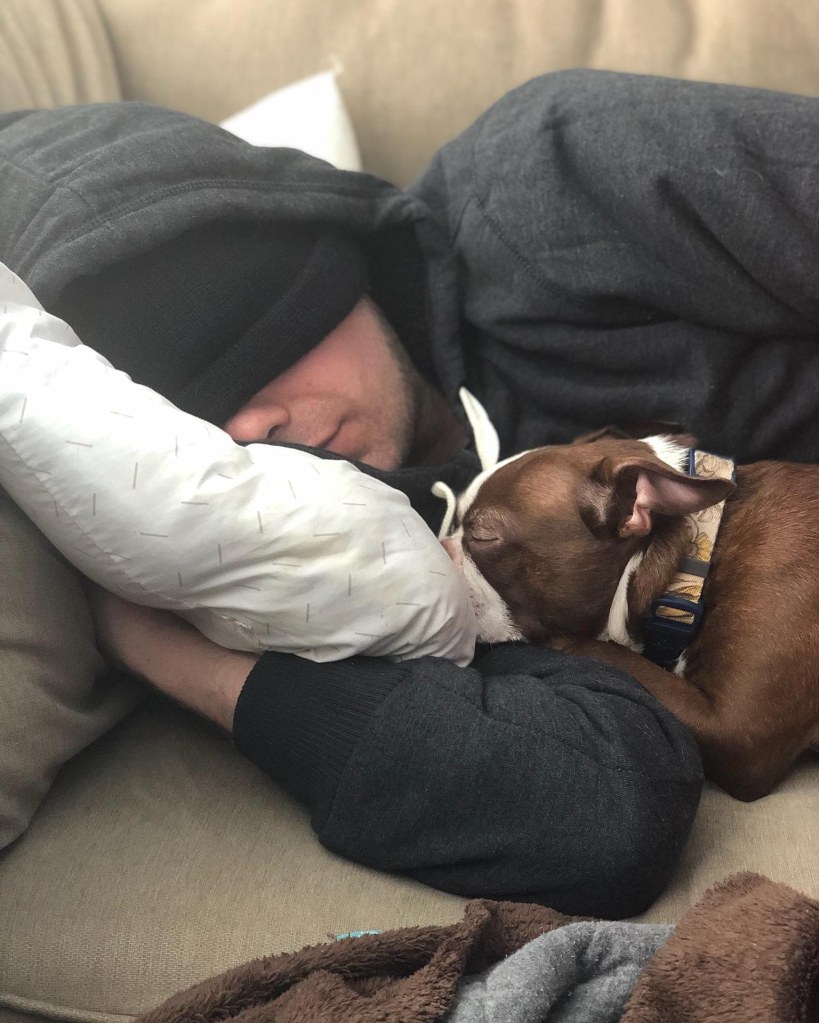
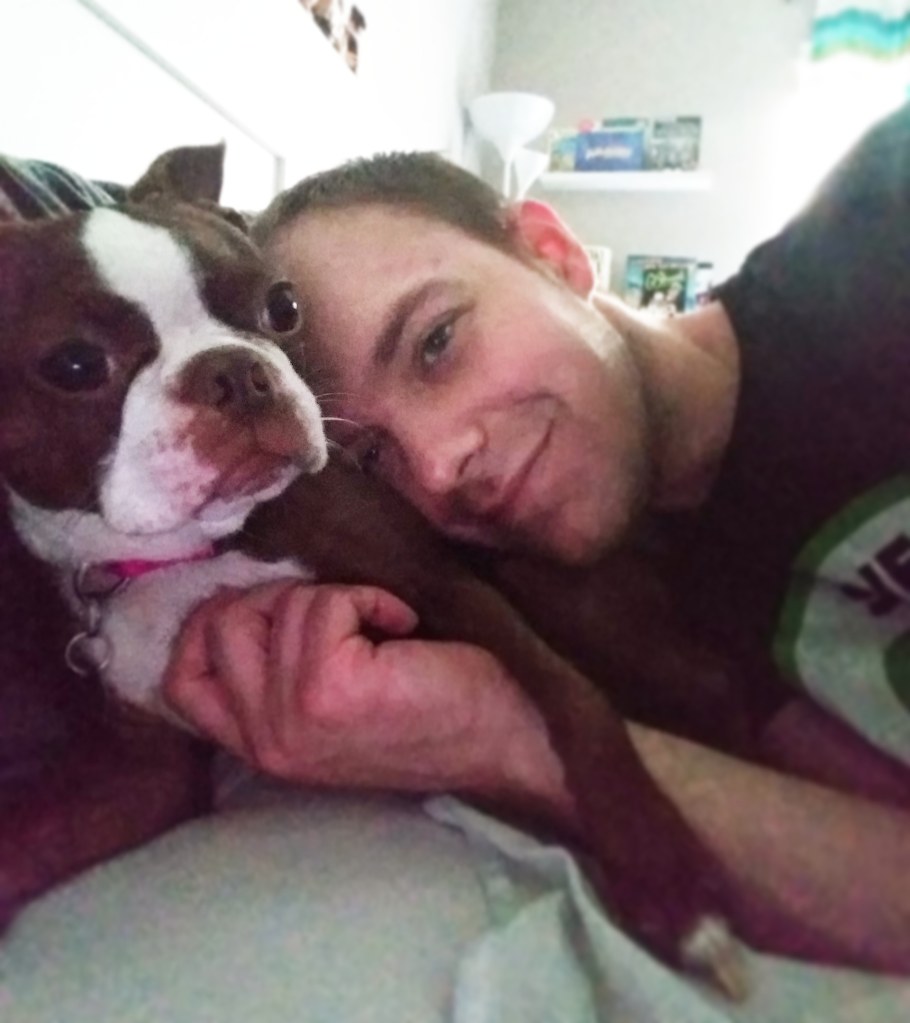
My dog is my number one fan, primarily because she cannot read my work.
April 3rd, 2019
“All art is a kind of confession, more or less oblique. All artists, if they are to survive, are forced, at last, to tell the whole story; to vomit the anguish up.” – James Baldwin
Since the anniversary of Them and Us on Monday, I’ve been rereading my work. There are many themes throughout the two books, but the one big theme that the entire story is about is the idea of control. People who are in it, people who want it, people who are controlled and people who have lost it.
The theme isn’t groundbreaking, but as I’m walking through this world again, it’s the context of the piece that makes it shine a whole lot brighter for me now.
See, five or six years ago, when I wrote these words, I was very much a terrified person who was out of control. And the only way I knew how to deal with it was through art. I couldn’t face my reality, so I used my words to try to make sense of the displacement and fear and the shame I was always feeling; to put my finger on the lack of control that gave me horrible anxiety and amplified every bad feeling and thought that I couldn’t turn off.
Art was the only thing that worked in a positive way in my life at the time.
So among the errors and marks and mistakes and the words of a lesser writer are grand ideas and even grander emotions, rooted in a really real truth for me and my soul. It’s less embarassing, and more flawed, and flawed for me now is good and important.
Art is important.
So in a way, these books helped me on a road that saved my life.
And one of my best accomplishments as a writer was coming up with an ending that is either extremely cynical or positively optimistic, depending on your outlook. It could even be both, like it was in my mind.
Anyway, this is just a reminder that everyone has something to say, and what you say is important — if not for anyone else, it’s important for you. Your ideas and thoughts and feelings are art and it’s up to you to put that paint on canvas. Because someone is waiting to hear it.
As a recovered/forever recovering person, I think the question I get asked the most is: “So when do the bad feelings and thoughts stop?”
I avoid this question. But I think, in the spirit of true transparency, I should answer it, and as honestly as I can: they don’t.
I still have bad feelings and bad thoughts, every day. That doesn’t ever change. What changes is that you learn better ways to deal with them. Or you learn that you CAN deal with them or, sometimes, that you even WANT to deal with them.
My generally positive attitude has been addressed by others, some curious, some hopeful, some incredulous, some doubtful. I’ve had people say to me it’s because life hasn’t crushed my soul yet.
I have to tell that it’s because it has.
Every time I look you in the eyes and smile, every time I say something nice to you or about somebody else, every time I try to help you or another person or people — I do these things not out of instinct, but because I choose to. I do not wake up in the morning with a balanced, blessed outlook on life. I am not a naturally positive human being. I look at myself in the mirror and I see flaws and I see hurt and I see scars but the biggest thing that has changed is that now I also see hope. I see today.
So the answer to the question appears dismal, but it’s not. Because anyone can choose. You can’t choose what happens to you, but you can choose how you go forward. I have days where a garbage human being will do or say something to me that could potentially ruin my own day, and my goat gets got just as much. But it’s what I do after now that matters. I take blame more, I apologize more (and more quickly), and I try to make anything I can better, too.
I choose to smile, and laugh, and be nice, and I choose to deal because that is the only thing that makes the bad feelings go away.
And they’re always waiting to come back. But being a better place, by dealing with you, means that you’re making a home in yourself that can sustain any storm.
For those of you at home keeping score, today I completed 15 months of sobriety. To share how I’ve been progressing, I Googled “15 months” and all of these things accurately describe me and where I’m at:
• Walking. Your 15-month-old is probably taking at least a few steps on her own. About half of 15-month-olds can walk well. A few are even running or starting to learn to walk backwards!
• Speech. Most 15-month-olds say at least one word. Half can say at least two words. And some tots will have now ventured past “dada” and “mama” to form a growing vocabulary that includes words like “dog,” “juice” and — if you’re still breastfeeding — “boobies.”
• Identification. Your 15-month-old is starting to understand what everyday objects are used for—a broom is for sweeping and a wooden spoon is for stirring, for example. Some 15-month-olds can identify and point to a few body parts when you ask them to show you.
15-Month-Old Behavior: While it’s awesome to have an active and (mostly) happy toddler, they have their, er… moments. A few challenging behaviors at 15 months are:
• Tantums • Separation Anxiety • Throwing Things
This is all me in a nutshell, Squirrels.
In all seriousness, if you’re on the same journey as me, congrats on your months, your years, your decades — but most duly, I’m proud of your day, your 24 hours, because today, as you know, is all we have.
Why is “What doesn’t kill you makes you stronger” such a commonly used phrase? I know some of the greats use it (I’m looking at you, Kelly Clarkson), but it is inherently false.
What doesn’t kill you rarely makes you stronger. What doesn’t kill you can harm you, hurt you, cut you, bend you, break you, weaken you, destroy you and, sometimes, it can kill you. The problem with the phrase is that it implies that simply because you have survived a situation, you are now a better, stronger person. And that is simply untrue.
Dealing with what didn’t kill you, finding love and support from family and friends when you need it and offering it when you can, using what didn’t kill you to help other people who are going through the same things — those are examples of things that make you stronger. Don’t believe for a second that just because you’re alive you have an automatic contract with life to buck up and be tough; you are allowed to be hurt and to be weak, with the understanding that you can shape your raw situations and feelings into something that is strong.
Just remember that the next time someone says that to you. You don’t have to be something because you lived through something; but being here regardless is still something
Going into something with the intent of not liking it during and after is a very popular pastime for a lot of people. Whether it’s having preconceived, negative opinions and judgements on movies, television shows, books or any other forms of art and entertainment, people just really love to hate things they haven’t seen or don’t watch anymore. (This is the part where over half of the people reading my feed quickly react in their minds, saying, “No, YOU DO.” But for real, you do it, and it’s obnoxious.)
Nowhere in pop culture is it worse than with @nbcsnl. If I had a dollar for how many times in my life I’ve heard people say SNL sucks, or talk about “how much better it used to be,” I would buy muzzles for all of the people who participate in this conversation of futility. Whenever I hear anything along these lines, I always ask: “But do you still watch it?” 99 out of 100 times I get excuses or variations on the word “No.” Which is mind-boggling. Like — how do you know anything about something you don’t know?
Last night’s episode with John Mulaney was outstanding. But this sketch stuck out, not because of how laugh-out-loud funny it was, but how refreshing its topic and tone were. John played a character who accompanies his girlfriend to an all-black wedding. He’s nervous about how everyone is going to react to him, but as the sketch cha-cha’s on, you learn his character not only already knows a lot of the people at the wedding, but he’s a positive part of their lives, as they are his. It’s an inclusive, heart-warming sketch, and one that is apt to get lost among the lunatics who think SNL and its political leanings are harsh or wrong — our president is the lunatic, and if SNL did anything else but put that on display for the world, then our comedians would have clearly lost their way.
What I’m saying is that if you want to have an intellectual, positive conversation about a piece of work, either consume the entire piece of work and have an informed opinion, or don’t be surprised when everyone starts to discount your opinions on everything. You earn your place as a person who respectfully disagrees or opposes. It is not a right; it’s a privilege.