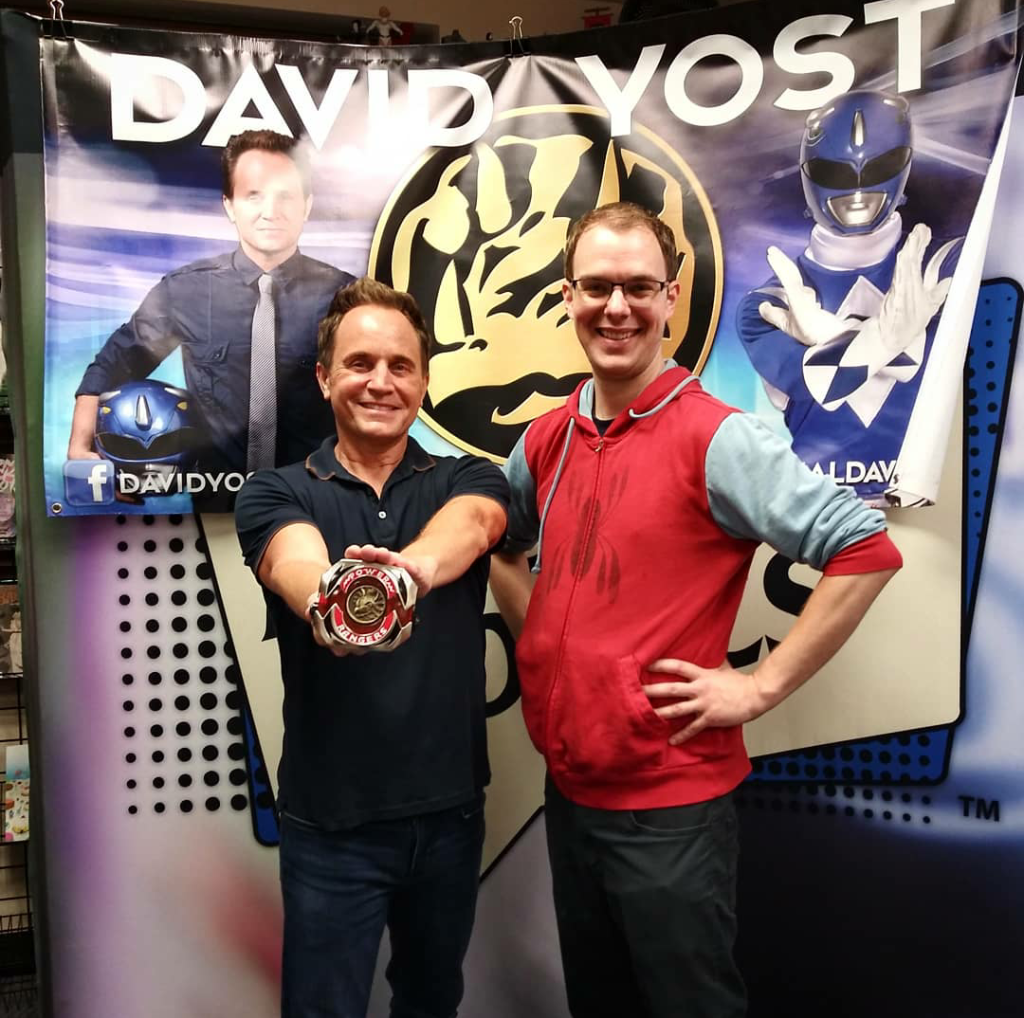
Morphin’ Time

June 26th, 2021

GEEKING. OUT. (Politely, of course.)

It’s no secret that my pop culture influences are deep, vast, and embedded in my DNA. But few can call themselves legitimate cornerstones of my youth, and Power Rangers is definitely that.

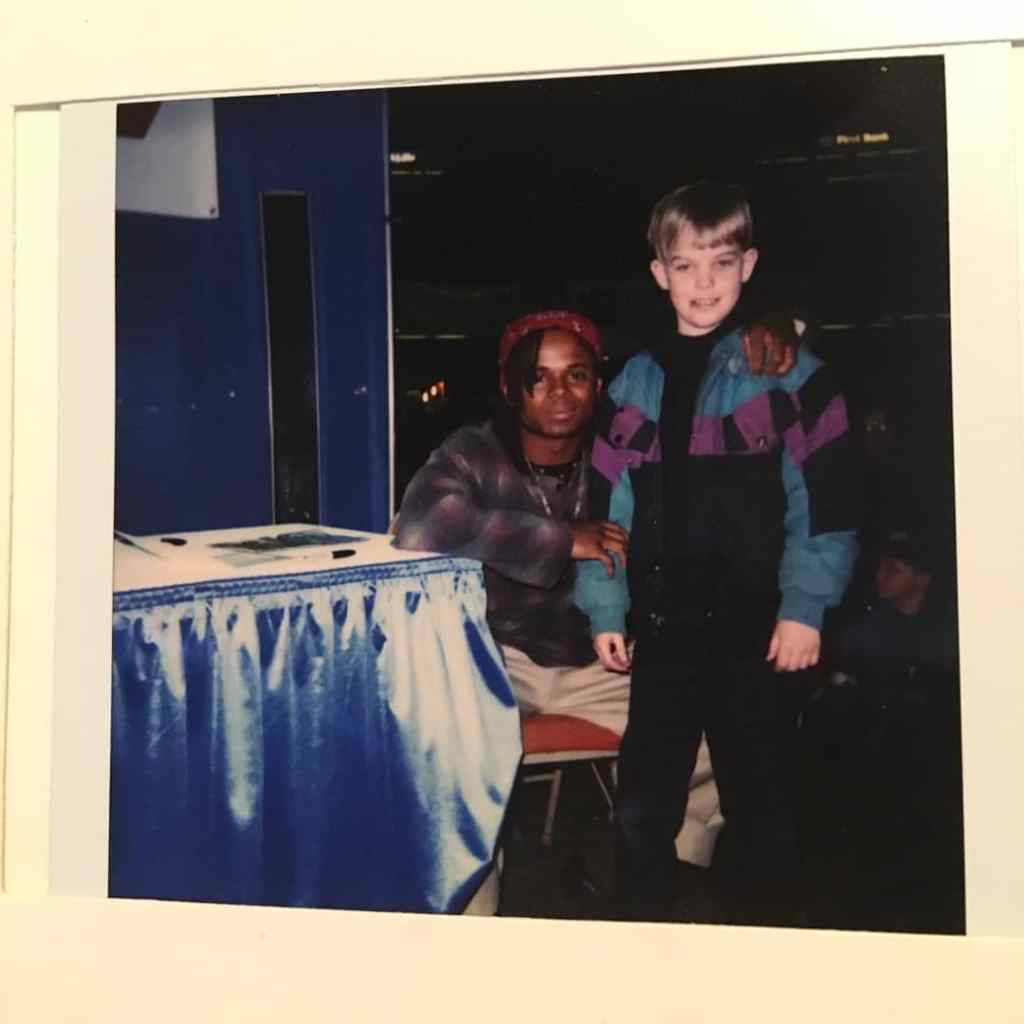
When I was a young(er) dude, my dad took me to meet Walter Jones, the Black Ranger; I got a Polaroid with him and he signed Power Rangers #1. For years I told people about this, but I had lost the evidence, forever, or so I thought. When my mom passed last year, I got boxes of stuff she saved of me, and I found these treasures inside, vindicating my oft-told tale.

When I found out that one of the best comic book stores on this entire planet was hosting David Yost, aka Billy, the Blue Ranger, my heart knew it was morphing time once again. It brought back those imperfect memories of nostalgia, those Saturday mornings with the Rangers, the birthday parties, the time spent playing with my mom. It was all the best things, and David was just the kindest dude, and I hope he got that kindness back in Minnesota today.

A mighty thanks to Eric and Neal and everyone at Mind’s Eye today for having this event. It was really special to be able to meet another hero of a beloved team I always wanted to be a part of growing up.

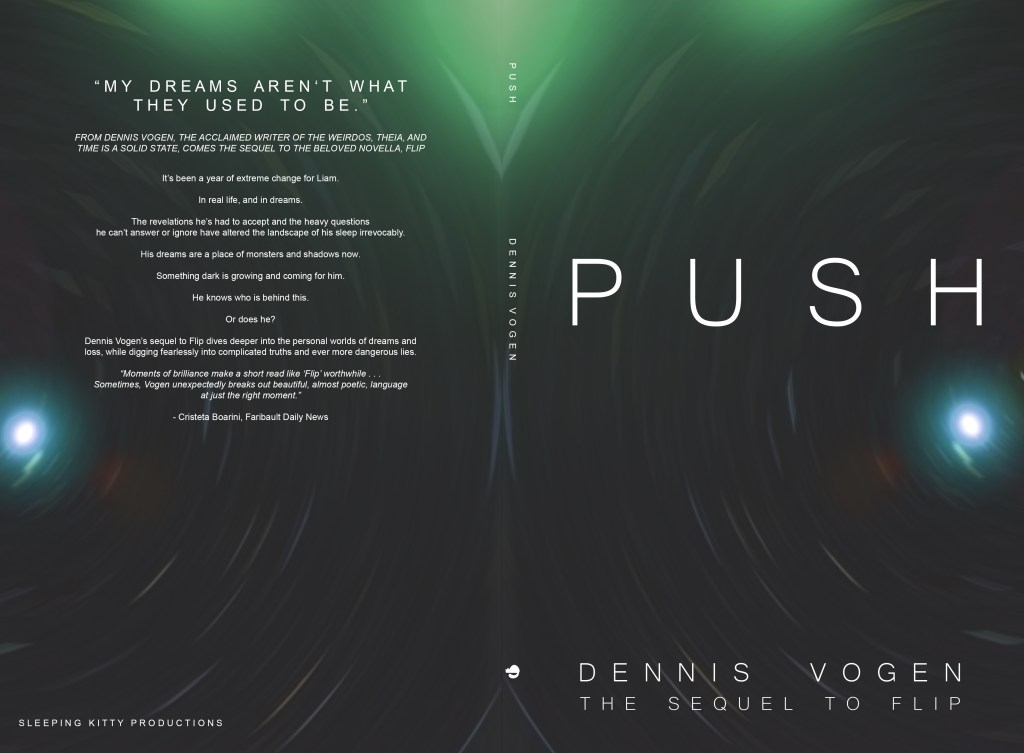
Push Exclusive: Full Cover & First Description

June 24th, 2021

We’re less than a month away, and I have an exclusive look at the full cover for Push, and the official description for the highly anticipated (if not just eagerly awaited) sequel to Flip!

“My dreams aren’t what they used to be.”

FROM DENNIS VOGEN, THE ACCLAIMED WRITER OF THE WEIRDOS, THEIA, AND TIME IS A SOLID STATE, COMES THE SEQUEL TO THE BELOVED NOVELLA, FLIP.

It’s been a year of extreme change for Liam.

In real life, and in dreams.

The revelations he’s had to accept and the heavy questions he can’t answer or ignore have altered the landscape of his sleep irrevocably.

His dreams are a place of monsters and shadows now.

Something dark is growing and coming for him.

He knows who is behind this.

Or does he?

Dennis Vogen’s sequel to Flip dives deeper into the personal worlds of dreams and loss, while digging fearlessly into complicated truths and ever more dangerous lies.

“Moments of brilliance make a short read like ‘Flip’ worthwhile . . . Sometimes, Vogen unexpectedly breaks out beautiful, almost poetic, language at just the right moment.”

– Cristeta Boarini, Faribault Daily News

“Dennis Vogen is brilliant! . . . I laughed, felt sad, and ultimately wanted to give each character a hug.”

– Danielle Leukam, author, Four Pounds of Pressure [Goodreads review of The Weirdos]

Pre-order will be up soon! This story has been a long time coming and I can’t wait for you to experience it.

Cats Giving Men Fish

June 23rd, 2021

If you want to make an adult suspicious, be nice to them.

That sounds counterintuitive, but it’s not.

Common wisdom tells us that as we get older, we are required to become less naive, more cautious, and to refrain from being blindly kind to people in order to prove to others that we are mature adults and not gullible children.

We are expected to trust no one, no system or organization or human being, because trusting things is stupid. In fact, if you find yourself trusting someone and you get let down, we’ve become conditioned to blame the person who had trust and not the person who broke it.

Let me tell you something.

I’ve spent time with garbage folk and have dabbled in being garbage folk myself. And every time I betrayed someone’s trust, it said nothing about them, and everything about me.

I genuinely like being nice to people. I also like trusting them. And on a regular basis, when I’m doing one, the other, or both, people will comment that I must be that way because I’m not old enough to have truly experienced the world for what it is, and that someday (you watch!) I, too, will be a jaded, weary soul.

When the truth is, I’ve already been to the bottom of that well, and I choose to embrace radical empathy, compassion, kindness and trust, anyway.

We are all going to end up at the bottom of the sea eventually, and you get to choose the ship you sink on.

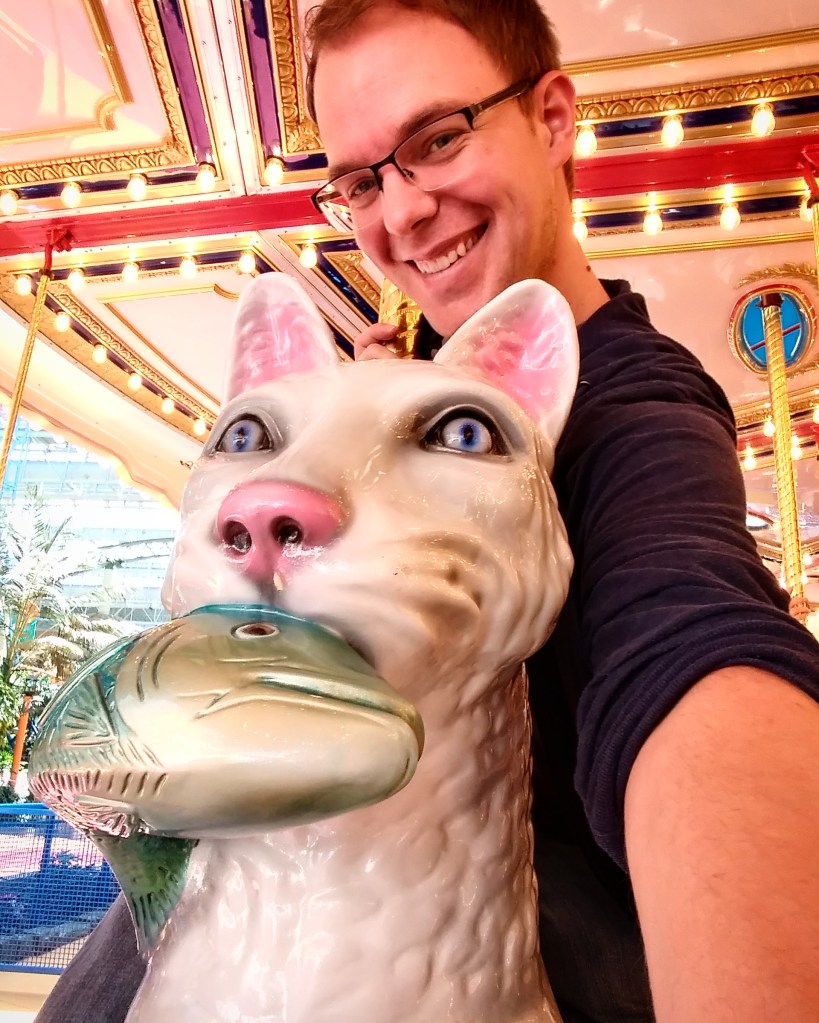
We went on the carousel today. Check out this cat I rode. He’s carrying a fish in his mouth, clearly a gift for any weary rider who finds themselves on his back. Some people might call this cat dumb; not everyone deserves a meal, and not every stranger deserves kindness.

The cat disagrees. He is happy to serve, and he doesn’t believe that your suspicion makes you smart, or mature. He knows there are more fish in the sea, and he won’t stop sharing, or trusting, until it’s the last thing he ever does.

2%

June 21st, 2021

Sometimes it takes an animal’s perspective to help us understand our own lives; the way that humans tend to overcomplicate things often gets in the way of seeing them clearly.

This has become very apparent as I finish up hundreds of pages of squirrel research.

I have fun facts for days (I can explain to you at length why squirrels will eat white oak acorns today and bury red oak acorns for later) but I’ve been thinking about this particular anecdote a lot lately.

In general, female gray squirrels practice something called natal philopatry; it means that, more often than not, they will remain in the same home where they were born after they mature. It allows them to have strong bonds with kin and build generations of family. Male gray squirrels, on the other hand, almost universally leave their place of birth once they’re of age.

Almost universally.

In one study, the scientists noted that 2% of the male squirrels they observed did not leave their nest once they were grown.

These two squirrels had lost their mother at a young age.

And realizing that grief has an enormous impact on even a creature so small is a powerful realization.

We wonder why we can’t just move on, and we analyze it and we rationalize it and we expect to be the same person more or less after it happens. Animals show us that loss is life-altering in a permanent way that can’t be explained by words.

Humans love to think that our intellect means we experience certain things that no other creature could possibly get. Animals show us that grief is universal, and humans aren’t lucky enough to carry it alone.

Everywhere You Look

July 20th, 2021

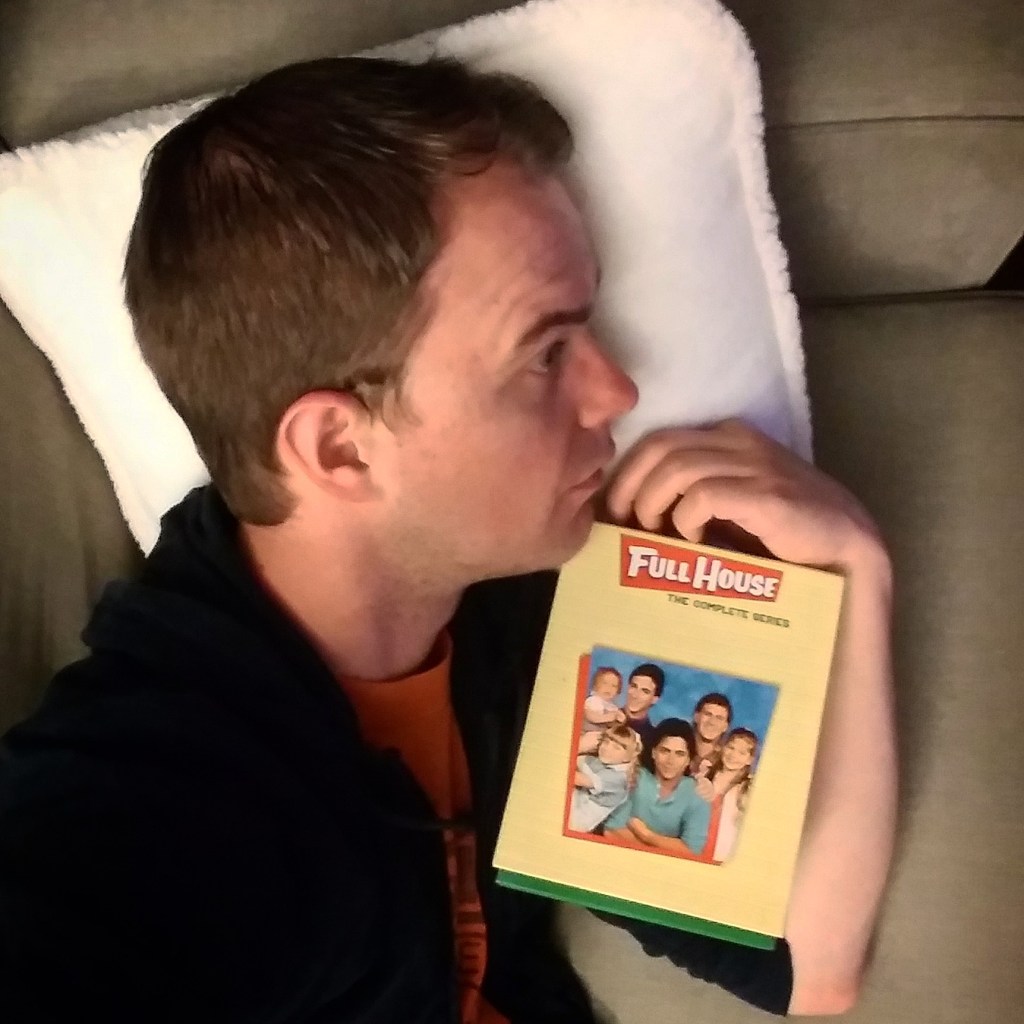
It’s been brought to my attention by multiple people over the last few weeks that I have been talking about Full House a lot, and watching it with curious regularity.

I wouldn’t be me if I didn’t begin questioning why I’ve been doing this.

With the 90’s being the latest era to be co-opted as a trend by a later generation, I’ve again been reading and watching a lot of viewpoints on the power of nostalgia (which is an entire essay in itself).

There is one point in particular that has been highly resonating with me:

Nostalgia exists because of our imperfect memories.

And as soon as I reconciled that theory with my behavior did I figure out why Full House has been on my mind.

I grew up as part of the TGIF generation, and Full House was the crown jewel of that line-up in our household. I don’t know if our family missed an episode, and I have so many warm memories of those Friday nights.

One-liners, guest stars, musical numbers, marriages, pregnancies, deaths — the show opened doors to actual conversations and real feelings and it was a major part of my childhood.

And thinking about that made me realize I had, like almost everybody else, an imperfect childhood, but those nights spent with my mom and the rest of my family felt perfect. And keeping the artificial parts, the episodes of an old TV show, running through my head gives me very real feelings of peace and security and happiness.

It’s a coping mechanism, and one that has been helping me with grief since day one.

I guess what I’m trying to say is if someone around you is dealing with stuff and they’ve found themselves obsessed with the healing properties of their favorite piece of nostalgia, you should heed the words of Uncle Jesse when dealing with them: have mercy.

And if they ask you to sit down and enjoy an episode with them, it doesn’t take much to respond: you got it, dude.

Let’s Talk!

June 19th, 2021

Hey.

Are you the one-in-three Americans who currently has a podcast? Let’s talk.

Are you a prolific blogger who does interviews or individual features as part of your content? Let’s talk.

Are you a journalist for a local publication or writer for a website who needs subjects for spotlights or specific interest pieces? Let’s freaking talk.

I am open to be a guest on whatever it is that you do. Drop me a line and let’s create something fun together. Or something absolutely bananas. That all depends on what it is you do. Let’s talk.

Change, or Die

June 16th, 2021

Working in a bar as long as I have, I’ve heard a lot of stories.

Most of them about other human beings. Most of them some kind of drama or hardship or horror.

Quite a few of them about people who didn’t make it.

Some of the people just had bad luck, uncommonly. But most of the stories about the people who have tragically passed are the stories of a downward spiral. Of a battle. Of a war.

About a person who couldn’t beat the dark thing that lived inside of them. (Or even find ground to negotiate.) And these stories, they inevitably lead to worse ones, and the conversation invariably evolves into one of inevitably, impossible odds, “I knew it was going to happen,” “People like that don’t change.”

The next time you’re in a conversation like that, will you do me a favor? Tell them, “Actually, I know a guy…” And feel free to tell them anything you want about me.

Mind you, this isn’t about me. This is about changing the trajectory of the conversation. Instead of accepting the things that can clearly be changed, this is about injecting our words and intentions with hope.

Because you never know who is listening to those stories.

It used to be me, behind the bar, swallowing every word. Believing in the inevitability of the monster I have in me, and make no mistake: it is a monster. Rarely, if ever, did I hear these conversations steer towards the kind of compassion and happy endings that are not only possible, but the way the universe bends.

We’re not meant to be solely our worst. We are meant to make mistakes and grow and share what we know to help others who do not.

“Change or die,” I repeat to myself, like a mantra (I stole the phrase from Neil Gaiman). Maybe not literally; but the moment we decide that we can’t learn anything new in this world is the moment we stop being a living, breathing part of it.

Fifty First Rates

June 15th, 2021

There’s this magic number we think about often as self-published writers: 50.

That’s the number of reviews to takes on Amazon to get their attention.

It is both a small number and (as someone who’s largest set of reviews is 7 for a book that’s almost 8 years old) an impossibly great one.

So I want to answer a question I get all the time: “Why do you write and publish books?” But I want to answer it specifically for Time is a Solid State, which is essentially my internet feed in book form.

There are lists and lists of writers who weren’t discovered or appreciated until they kicked that cruel bucket. Emily Dickenson had her first book of poetry published just in time — for the fourth anniversary of her death. Henry David Theroux self-published his now-classic works and sold few (which sounds uncomfortably close to my story), but Henry also didn’t have the internet in the 1800’s. Writers like Herman Melville and poet John Keats were both published in their lifetimes, but also considered themselves to be complete failures due to the initial critical responses to their work. (I mean, people hated it.) And H.P. Lovecraft didn’t have his stories published in book form until a few years after his passing (though that may have been tongue-in-cheek instant karma on behalf of his rampant racism).

Their deaths didn’t change the words they wrote. No, they were speaking for so many hearts the moment they put their pens to paper and fingers to keys. It was just that the words weren’t out there, in so many cases, and the eyes that needed to see them took too long.

And that’s why I published my internet ramblings. Over the years, I’ve received so many heartfelt comments and messages over these essays that I sincerely put my all into, day after day. And I figured that if they connected with people the way that I craved, in ways that I don’t see others writing, then maybe there’s a bigger audience out there for that.

And instead of death, all I need is 50 Amazon reviews.

But gosh: what a great number.

(You can review Time is a Solid State on Amazon TODAY. ⭐⭐⭐⭐⭐)

Dedication

June 14th, 2021

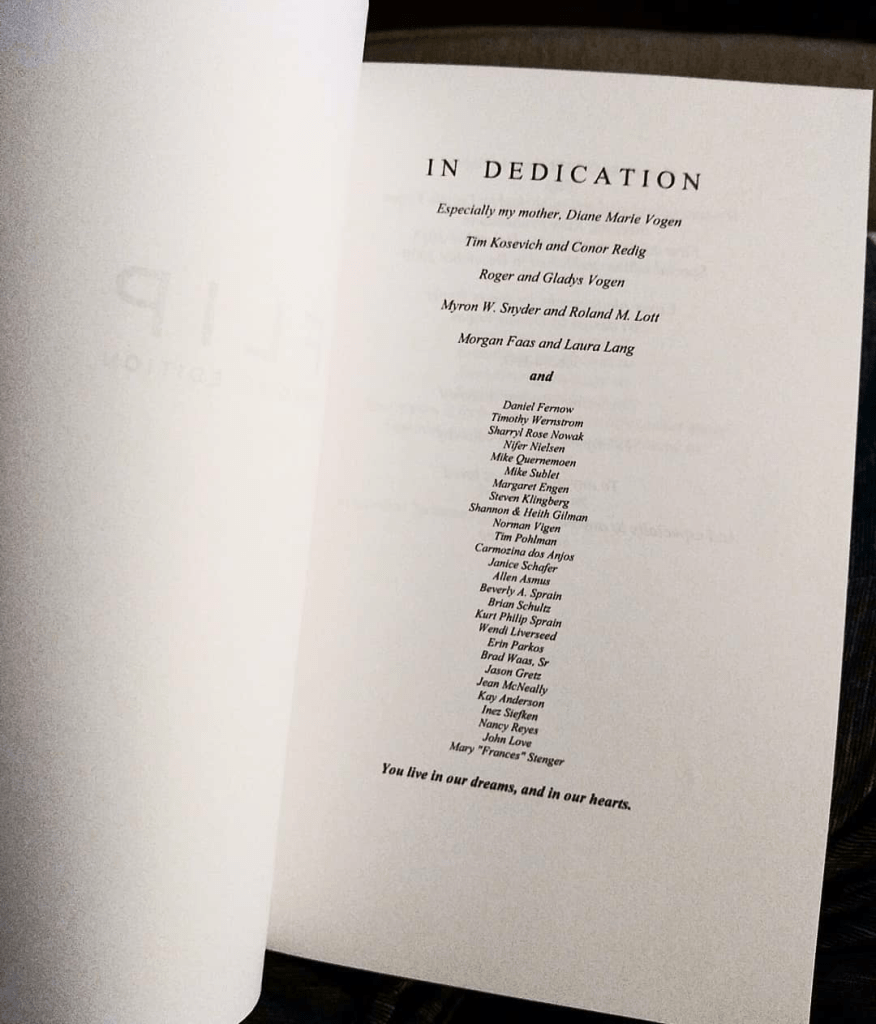
One of the major themes of my novella Flip is loss. When I published it back in 2013, I wanted to give others the opportunity to honor people they’d lost by including a special dedication page in the front of the book, allowing anyone, who wished to, a space to remember a person they love.

The themes of its upcoming sequel Push are more complex, but loss still carries throughout, and I want to offer this space again to anyone who would like to use it.

The cost is free. All you have to do is leave the name of your loved one here in the comments (or through a message if that’s more comfortable) and I will include it on the dedication page in my next book.

It’s been an especially traumatic year of loss for many, certainly for me personally, and the most essential thing that has helped carry me through is simple remembrance; memories and photos and handwriting on yellowed sheets of paper. This is another way of memorializing, and it’s open to everyone.

Hope you’re all hanging in there, and I hope to hear from you. All my love.

Manufactured Bottled Lightning

June 10th, 2021

I mean this in the creepiest possible way but you don’t know what your brain is thinking most of the time.

This post is about your subconscious mind and how it relates to inspiration, supposed intervention, and mental blocks, ebbs and flows.

I forgot what I was going to say.

I’ve done a lot of reading about the subconscious, and have had significant personal experiences that have shown me the unbelievable nature of our human minds. It would be impossible to exaggerate how powerful your brain is, and equally as difficult to explain what I’ve experienced in a meaningful way.

But let’s start with a basic fact: at any given moment, you are only concentrating on a small percentage of what your mind is fully doing. Think of your brain activity as a massive grid mapped around your head; you can only focus on the lines that you can see right in front of you, but the entire grid exists, and is operating, all the time.

This means that you are always thinking about so many things that you have no idea you’re thinking about.

This allows thoughts to jump into your consciousness fully formed, like somebody is telling them to you. This is what a lot of creative people perceive as inspiration; many people also receive this information as divine intervention, or talking directly to God.

I’m not here to take away any belief from anybody; if you believe that melody or story idea or life-changing revelation came from a higher power, more power to you. But, to me, the idea that all ideas come from within is a much more powerful one.

I know a lot of creative types who get blocks, and those blocks create anxiety and stress and panic. I used to get that way, until my own subconscious started coming through for me, again and again and again. It’s why I’m so prolific and work so quickly; not because I’m smart or better than anybody else (nope on both counts), but because I recognize how the human brain works, and instead of working against it, I let it do its thing.

There are some problems you can work through. There are others that have to work themselves out and then will come to you.

So call it what you want. But I found that when I realized all this power lived inside of me, I didn’t have to go looking for it anymore.

And it was the opposite kind of soul-searching I didn’t know I needed.